

Introduction: “Us do opposite of all earthly things”
In June 1961, American comic book writer Jerry Siegel, who co-created Superman along with Joe Shuster twenty-three years ealier, offered the readers of Adventure Comics #285 the Bizarro code: “Us do opposite of all earthly things; us hate beauty; us love ugliness; is big crime to make anything perfect on Bizarro World.” The code articulated in a nutshell the surreal way of thinking of Bizarro, a grotesque duplicate of Superman created by Otto Binder and Wayne Boring and whose adventures featured satirical inversions of normal logic, everyday expectations, and common-sense morality, all expressed via eccentric antonyms. Siegel’s interest in the character at that time mirrored his recent legal failure in reclaiming the ownership of Superman from DC Comics: the upside-down Bizarro code sarcastically reflected Siegel’s loss of control of his original creation (Gordon 2017: 53-56).

The Bizarro Code. SOURCE: ScreenRant. © DC Comics
In a key story by Binder and Boring, published in Action Comics #263 (April 1960), the original Bizarro produces imperfect copies of Superman and Lois Lane, with which he populates an upside-down world where everything is logically inconsistent and haphazardly assembled, like useless clocks with their numbers completely out of order. When Superman notices the “foul, dilapidated conditions” of the houses on Bizarro World, he tries to put things back to normal, only to be imprisoned because, as enshrined in the Bizarro code, “is big crime to make anything perfect on Bizarro World” (cf. Cowsill et al. 2016: 100). On the cover of the issue, a handcuffed Superman stands trial before a jury entirely composed of Bizarro Supermen and multiple Lois Lane, with the original Bizarro decreeing under an illegible clock: “Us find the defendant, Superman, guilty! Us order court to change you into a Bizarro like us!”. Readers are then treated to Superman’s inner monologue: “There is no escape! I’m doomed to spend the rest of my life on this mad world!”.
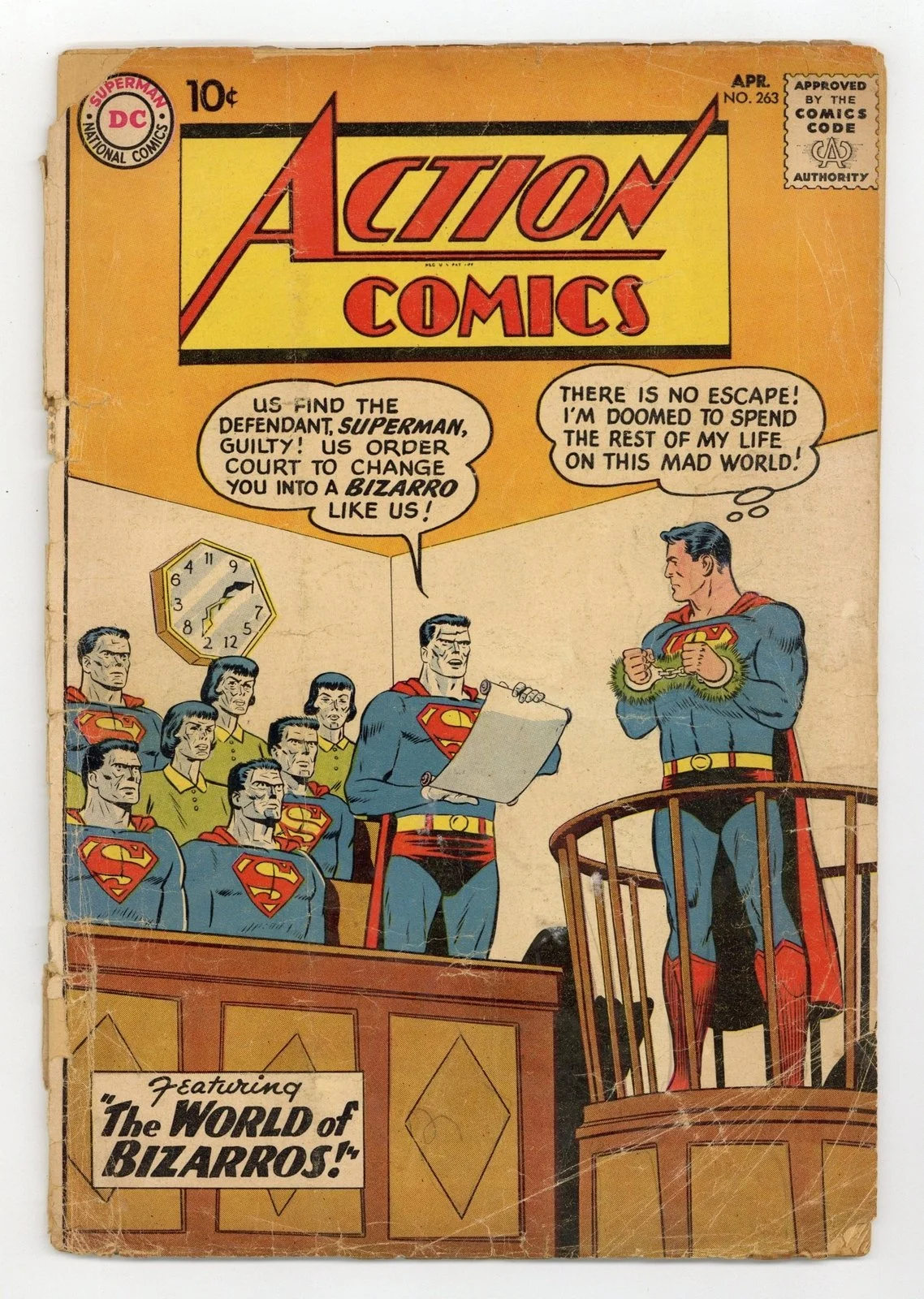
The cover of Action Comics #263 (April 1960). SOURCE: eBay. © DC Comics
It is hard not to feel as dejected as Superman when confronted by the products of Eliadology, the sub-branch of History of Religions (HoR henceforth) devoted to the historiographical study of Mircea Eliade’s (1907-1986) life and works, arguably the most important, most widely read, and most polarising historian of religions of the 20th century.
To recap a quite tortous history, the vexata quaestio of Eliade’s support for and involvement in the Romanian interwar ultranationalist movement of the Legion of the Archangel Michael (also known in its various incarnations as Legionary Movement and Iron Guard), as well as the related political party Everything for the Fatherland, resurfaced even more forcefully after his death mainly thanks to the pioneering criticism spearheaded by Italian scholars in the late 1970s. Since the late 1980s, an ever-growing body of detailed biobibliographical studies has gradually brought to light the disquieting and metapolitical continuities between his disciplinary, literary, and journalistic production, his antiscientific ethos, and his political and spiritual ideas (see the bibliographies available in Ambasciano 2014, Ambasciano 2019, and Lincoln 2023; for a primer on postwar radical-right metapolitics see Griffin 2018: 117). Against this backdrop, Eliadology has instead adopted some degrees of historiographical revisionism, ranging from mildly to extremely apologetic, with the authors involved sharing at least some of the disciplinary (i.e., antireductionistic, pro-paranormal, and antiscientific), political (i.e., from conservative to antidemocratic and ultranationalist), or spiritual (i.e., religious, esoteric, or meta-theological) concerns of Eliade, occasionally coupling such penchants with a poor knowledge of Romanian Interwar culture (whether in good faith or not). Sometimes the Romanian historian of religions is transfigured into some sort of unquestionable prophet, guru, saint, founding father, or intellectual paragon (Ambasciano 2021a), but at other times the reasons behind a lack of critical engagement are more complicated and strictly personal (Eliade was generous – or strategically manipulative – enough to help many a US talented young scholar of the postwar generation secure their careers and jobs, who in turn felt obliged to reciprocate by keeping their criticism to themselves) (Lincoln 2023: 136).
To complicate matters still, since the 1960s, and coinciding with Eliade’s teaching at the University of Chicago, the historian of religions’ core ideas, developed within the milieu of reactionary, radical-right Interwar Romanian culture and re-elaborated during his post-war Parisian years, have been increasingly adopted by left-wing intellectuals and progressive scholars, thus contributing to the “ambivalent legacy” and paradoxical survival of Eliade’s works within an “antiglobalization, postcolonial, ecological” framework (Ginzburg 2010: 332; as a corrective against any potentially liberating perspective about Eliade’s alleged anticolonialism see Câstorcea 2023: 136 and Ambasciano 2014: 296-305, 396-397). This paradoxical development replicates the same circumstances that allowed progressive 20th-century intellectuals and artists as diverse as George Lucas, Michel Foucault, Jacques Derrida, Cesare Pavese, and Pier Paolo Pasolini to find inspiration within the works and the camouflaged Weltanschauungen of ultranationalist thinkers like Joseph Campbell, Martin Heidegger, Georges Dumézil, and Eliade himself (see, resp., Ambasciano 2021b; Elden 2024; Ferraris 2014; Ferretti 2017: 120-124; Angelini 2020; Stochino 2023). In the last decades, this problematic ideological intermingling has given rise to “conspirituality, that is the mix of right-wing, quasi-mystical, gnostic and anti-establishment conspiracy theories and left-wing search for alternative, non-traditional and non-institutional religiosity, wellness, and spirituality” (Ambasciano 2021b: 264; on conspiracy theories, post-truth, and the radical right see Ambasciano, 2021c).
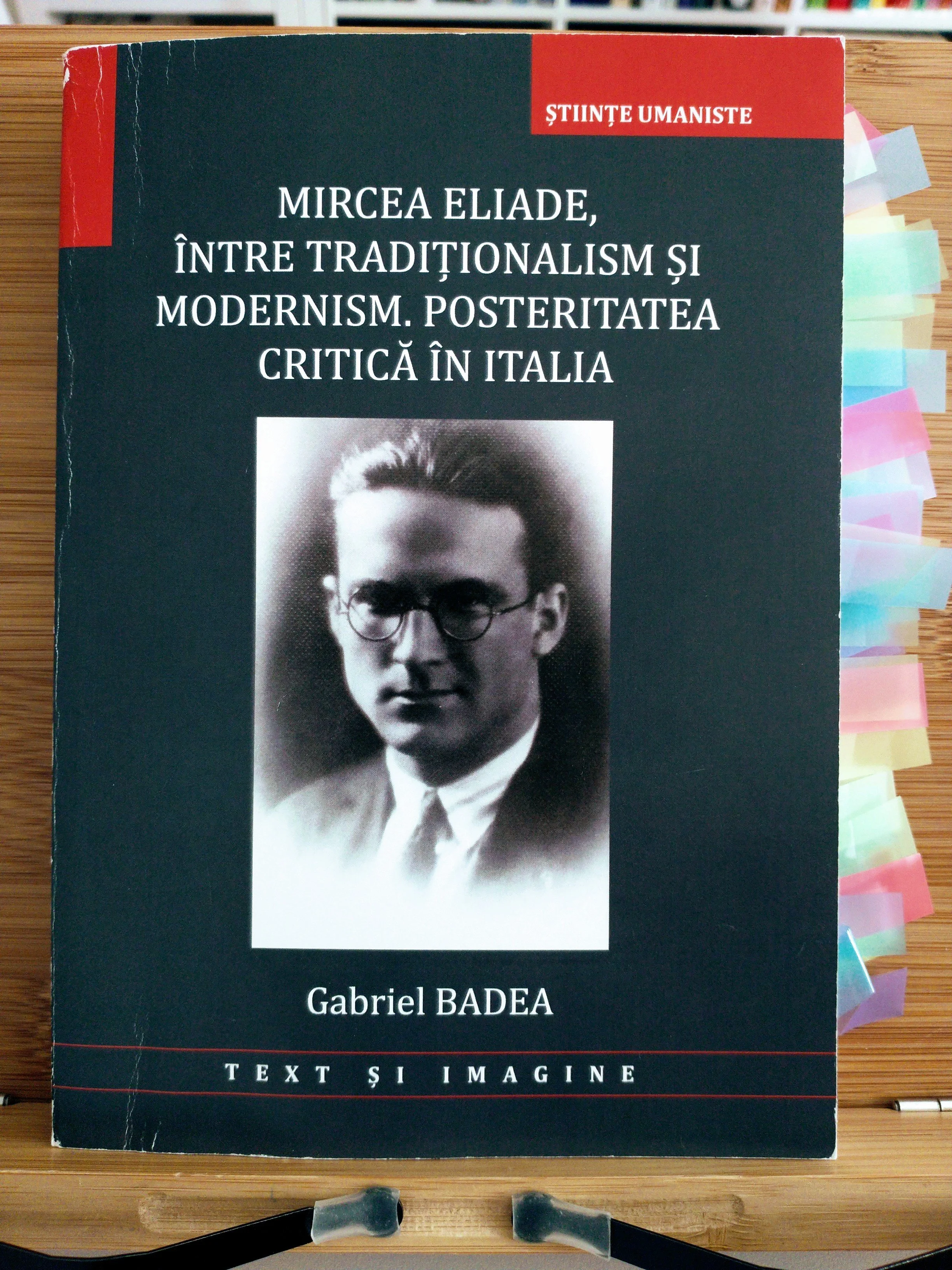
Despite the widespread academic consensus about Eliade’s controversial status, Eliadology has thus managed to turn a corner of academia into a “foul, dilapidated” knockoff of historiography where what is normally discarded as questionable or epistemically unwarranted is held in the highest esteem, who is usually recognised as a serious scholar is nothing more than a dilettante, and who is an unreliable intellectual with a poor command of method and theory is instead transmogrified into the non plus ultra of academic integrity. One of the latest example of Eliadological Bizarro historiography is found in a volume written by Gabriel Badea (affiliated to the Institutul de Istorie și Teorie literară “G. Călinescu” of the Romanian Academy in Bucharest) entitled Mircea Eliade, între tradiționalism si modernism. Posteritatea critică în Italia (“Mircea Eliade, between Traditionalism and Modernism. Critical Posterity in Italy”) (Badea 2022; unless otherwise indicated, all translations from Romanian, Italian, and French are mine, as mine are all potential mistakes).
“A spiritual adventure”
Badea’s book opens with an extremely positive introduction by International Association for the History of Religions (IAHR) Honorary Life Member, former European Association for the Study of Religions (EASR) Vice-President, and Current President of the Società Italiana di Storia delle Religioni (SISR) Prof. Giovanni Casadio. Therein the book, reimagined as a “kaleidoscope through which all the implications of Mircea Eliade’s life and works are reflected, with the completeness and the rigour of an encyclopaedia and the brilliance of an essay”, is presented as having to “offer much more than what is promised in the title”: according to Casadio, “for those who agree with the titular character, reading this book will prove to be a spiritual adventure, the rediscovery of a lost, yet necessary, Eliade” (7) (unspecified in-text parenthetical referencing is from Badea 2022).
After having described Eliade as the “Heroic cultural antagonist” of the Scuola Romana established by Raffaele Pettazzoni (here metaphorically transmogrified into a “Creator God”) [2], Casadio continues by deploying occult and psychoanalytical terms to present Badea’s main theses (“the pages devoted to the Journey [Călătorie] as an instrument for the search for both Self and Sacred are revelatory and almost therapeutic”; 7-8). Almost like an initiate recalling his Master’s induction into an unbroken chain of esoteric apprenticeship (the catena aurea of the prisca theologia that Badea describes in his book; e.g., 273), Casadio reports that he
“had the privilege of meeting [Eliade in Florence] in mid-June 1984. To talk about his critical legacy in Italy is, therefore, also akin to undertaking a symbolic quest [călătorie printre simboluri] into the very same history in which those symbols are buried” (7).
The “precious and acute analyses” provided by Badea, which “demolish the clichés about the relationship between Eliade, [esoteric] Tradition[alism], and the Legionary Movement”, along with Badea’s “acute judgments” about those scholars critical of Eliade’s work (labelled by Casadio as inchizitori, “inquisitors”), are accompanied by the exaltation of Badea’s thoughtful “structure of precise information about the critical fortune (and the misfortune) of Eliade in Italy” (8). A close reading of Badea’s own interpretation of my monograph Sciamanesimo senza sciamanesimo. Le radici intellettuali del modello sciamanico di Mircea Eliade: evoluzionismo, psicoanalisi e te(le)ologia (“Shamanism Without Shamanism: The Intellectual Roots of Mircea Eliade’s Shamanism: Evolutionism, Psychoanalysis, Theology, and Teleology”; Ambasciano 2014) , which doubles as a sample testing of Badea’s analysis of the critical reception of Eliade’s works in Italy, should clarify whether Casadio’s enthusiastic presentation of Badea’s volume is warranted.
Deviating from the norm
Badea introduces my book after a brief discussion of Pietro Angelini’s volume L’uomo sul tetto. Mircea Eliade e la “storia delle religioni” (“The Man on the Roof: Mircea Eliade and the History of Religions”; Angelini 2001), which is criticised as being too harsh because indifferent to Eliade’s own hermeneutic and phenomenological criteria insofar as the study of shamanism is concerned, as well as “far too hostile” against an author “who had just reached in those years [My note: the second half of the 1940s] his full intellectual maturity” (114). Whatever the minutiae of the disciplinary discussion in question, pledging allegiance to such a specific methodology in such bizarre and extra-epistemic terms does not seem to bode well for my book (114-115; cf. the bibliographies in Ambasciano 2014 and Ambasciano 2019). Sure enough, the same criticism is levelled against my Sciamanesimo senza sciamanesimo just a few lines below:
“[Ambasciano’s book] is impressive in terms of its sheer length (over five hundred pages [My note: 522 pages of text, 624 pages including both bibliography and index]), and is based upon a PhD dissertation elaborated under the supervision of Professor Natale Spineto. We find ourselves before an interdisciplinary text, here and there wordy [pe alocuri prolix], with an impressive bibliography, which nonetheless deviates frequently and excessively from the standard research programme of the History of Religions [dar care adesea se îndepărtează excesiv de planul istoriei religiilor]” (115).
A couple of corrections are in order. First, my book was not “based upon” a PhD dissertation; instead, it was an updated, expanded, and improved edition of my MA thesis in the History of Religions written at the same time as I was doing research and writing my PhD dissertation in History, entitled No Man Ever Heard Her Name: A Re-Examination of the Roman Cult of Bona Dea In the Light of Deep History, Cultural Evolution, and Cognitive Science (the original Italian title being “Nessun uomo sentì mai il suo nome. Un riesame del culto romano di Bona Dea alla luce di storia profonda, evoluzione culturale e scienze cognitive”), both under the formal supervision of Prof. Spineto at the University of Turin, Italy. According to his own Acknowledgements, Badea carried his five-year-long research in the libraries of “three great Italian academic centres: Turin, Venice, and Rome” (20; my emphasis). Badea specifically acknowledges the help of Spineto, along with Casadio, Roberto Scagno, Corneliu Horia Cicortaş, and Sorin Alexandrescu during his research (20; my emphasis). Finally, the biographical sketch on the back cover states that the his volume is the result of a postdoctoral research carried out in three phases [trei stagii de cercetare postdoctorală] between 2014 and 2019 at the University of Turin, the Institutul Român de Cultură şi Cercetare Umanistică in Venice and the Accademia di Romania in Rome, under the supervision of Profs. Natale Spineto, Sorin Alexandrescu, and Giovanni Casadio” (my emphasis). All of this makes the aforementioned imprecision quite baffling (for a critical commentary of my cursus studiorum up until that point see Ambasciano 2020; my PhD dissertation has also been available on this website since 2019, which makes Badea’s mistake even more inexcusable).
Second, I fail to see the epistemic import of Badea’s reproachful remark about my work “deviat[ing] excessively” from the standard HoR research method. Assuming that by standard HoR Badea means a mix of hermeneutics and phenomenology, should any biobibliographical research be required to emically adopt the once dominant method and theory of its discipline, even if its epistemic foundations are potentially outdated, questionable, or falsified? Badea’s suggestion makes no rational sense within the epistemological framework of modern academia (Ambasciano 2018; Wiebe 2023), not to mention that standard HoR itself has no constitutive method nor does it have a unifying foundational theory, being instead a patchwork of various extra-disciplinary tools and approaches (see Ambasciano 2014: 2-5). However, once seen through the distortive lenses of Bizarro Eliadology, phenomenological and hermeneutical HoR as further elaborated by Eliade himself can be better understood as the be-all-and-end-all of humankind’s quest for spiritual meaning. Badea himself reckons that such a reframing of the discipline could hardly meet the basic criteria for non-theological academic research: Eliade’s “spiritual mission” (as summarised in Geertz and McCutcheon 2000) “was not accepted within the North American academic milieu, insofar as it implied a reduction of both scientific objectivity and self-imposed distance in relation to the researched phenomena” (345). And yet, Eliade’s HoR was successfully reshaped into a “saving discipline” whose “objectives were just not scientific anymore, being instead and primarily of an existential and spiritual nature” and which was better located “halfway between theology and teleology” (my emphasis; 345) – curiously, the same syntagm that I chose for the subtitle of my 2014 monograph to highlight the same conclusion, here unacknowledged by Badea (with the two terms fused to form “te[le]ologia”; Ambasciano 2014).
Ultimately, I agree with Badea’s opinion about Eliade’s HoR as a non-scientific and spiritual endeavour, which I believe is better understood as a degenerating research programme sensu Lakatos that – contrary to Badea’s opinion – should have no place within non-theological academia (Ambasciano 2018). I also concur with Badea that Eliade played a role akin to that of a “Jesuit missionary” within that very same academia (345, following Leach 1966); indeed, as Leonardo Sacco once noted, Eliade could rather be considered as “the initiator to the mysteries he had invented himself” (Sacco 2008: 280; this work is absent from Badea’s bibliography).
“Derrida’s scheme” and Jesi’s “psychoanalytic principle”
Badea recognizes that my book, by virtue of its sheer “magnitude”, “outshines the extremely simplistic interpretations of Furio Jesi and Daniel Dubuisson” (115). After such a backhanded compliment, Badea continues: “Ambasciano is passionate about palaeontology and aims to ‘deconstruct’, using Derrida’s scheme [folosindu-se de schema lui Derrida], the way in which Eliade analysed the problem of shamanism” (115). While I firmly believe that historical sciences such as palaeontology, evolutionary biology, and palaeoanthropology are necessary for a full understanding of the pseudoscientific distortions and blunders committed by Eliade insofar as his reconstructions of pre- and protohistorical human cultures and shamanism are concerned – as a matter of fact, these disciplines contribute the lion’s share of the epistemological efforts featured in the first part of my book – Badea chooses to ignore them, dismissing my interdisciplinary research to nothing more than a personal quirk (a “passion”). Instead, as we shall see, he opts to focus his critical attention on postmodernism, with muddled results. For the moment, it is sufficient to note that, since he does not provide any clear indication or disciplinary explanations concerning the differences between poststructuralism and postmodernism (Ambasciano 2019: 138-144), Badea’s critical reference to “Derrida’s scheme” comes across as disorienting insofar as he seems to cite Derrida elsewhere in the book in rather favourable terms, even though postmodernism appears to be his bête noir (as shall be clear in the following sections; Badea 2022: 339).
The quick synopsis of my book Badea provides the readers with should be enough to show the confusion underlying such contradictions. According to Badea, my book
“largely picks up Furio Jesi’s method outlined in Cultura di destra [My note: Jesi 2011] and based on the psychoanalytic principle that the scientist or the intellectual is dominated by their biography. This principle asserts that it is impossible to speak of scientific objectivity, as all hypotheses, argumentation schemes, conclusions – in a word, the theories advanced by an author – are imbued with the author’s subjectivity and the sociopolitical context that shaped at once their personality and the specific type of discourse. Such a thesis owes much to the two patriarchs of postmodernism [o asemenea teză a cărţii datorează mult celor doi patriarhi ai postmodernismului], Derrida and Foucault, the latter being inexplicably absent from the bibliography of the work” (115-116).
As pointed out by historiographers knowledgeable with Jesi’s biobibliography (e.g., Manera 2012), the Italian scholar’s method, once fully developed, was neither entirely psychoanalytic nor postmodern. In his more mature writings, Jesi adopted a non-reductionistic, materialistic, multidisciplinary approach indebted to Thomas Mann, Walter Benjamin, Ernst Cassirer, Theodor Adorno and, most of all, the works by Vladimir Propp, Georges Dumézil, and Claude Lévi-Strauss. Jesi’s book Cultura di destra (originally published in 1979) provided a social and critical semiotic analysis of 20th-century ultranational culture and radical-right metapolitics which, if anything, could be said to be more akin to Pierre Bourdieu’s sociology and contemporary Comparative Fascist Studies than Freud or Jung’s psychoanalysis (cf. Alciati 2022: 39-44). Considering that Jesi died in 1980, right before postmodernism became hugely influential in philosophy (Jean-François Lyotard’s The Postmodern Condition was originally published in the same year of Jesi’s Cultura di Destra; Lyotard 1984), at best he could be considered a pioneering but isolated and original representative of poststructuralism, as his approach autonomously preceded and developed in parallel with the one primarily elaborated by French philosophers (Manera 2015a).
In my book, I referenced Jesi’s “‘deconstruction’ through the concept of the mythological machine” just once, as a potential way to disassemble and study the basic components of the legionary movement’s construction of an ethnonationalist and Orthodoxist identity insofar as Eliade’s own Interwar Weltanschauung and post-war intellectual choices were concerned (Ambasciano 2014: 408). A few years later, in my An Unnatural History of Religions, I summarised Jesi’s “mythological machine” as the “dynamic use of mythographical discourses to reproduce power structures and engender an institutional system of authority within an imagined community” (Ambasciano 2019: 8), which fits particularly well within contemporary Comparative Fascist Studies (Ambasciano 2021). However, since Badea clearly states that he has no “hermeneutic” interest in Eliade’s legionary involvement, disingenuously judged against all evidence as a “conceptually very poor topic without evident links to religion, except for those invented by such authors as Jesi or Lanternari” (37; my emphasis), it is only natural for him not to invest much effort in understanding what Jesi originally wrote and what I subsequently elaborated upon his work. To be clear, neither I nor the intellectually mature Jesi supported the view that “it is impossible to speak of scientific objectivity” (interestingly, the closest Jesian quotes one can find in this sense betray the influence of old-school hermeneutics and phenomenology and would date from Jesi’s earliest production, from 17-year-old to his late 20s; see Manera 2015a); to state otherwise is a lazy and pernicious form of revisionism. I, for one, wouldn’t certainly label any historiographical and biobibliographical work highlighting the psychological impact of life events in the biographies of scholars or literary authors – and, up to a point, the reflection of such events into their academic or scientific production – as having adopted a “psychoanalytic principle”, however defined (cf. Rowland 2014). It would be just plain and simple historiography [3].
More bewildering still is the fact that in my book I only referenced classical psychoanalysis as a contextual influence on Eliade’s thought, whether positive (Jungian) or largely negative (Freudian), while criticizing the early discipline’s pseudoscientific method and theory, largely disproved or improved by further neuroscientific research (e.g., Ambasciano 2014: 66, 98-105, 265, 451-461, 488). Limiting my in-depth analysis of the roots, main influences, and developments of what I reconstructed as Eliade’s own peculiar “folkloric psychoanalysis” (Ambasciano 2014: 104, 107, 125, 348; see Ambasciano 2019: 97) to some sort of misguided postmodern psychoanalysis reveals Badea’s insufficient grasp of 20th-century academic historiography. Nonetheless, I feel like more context is needed to clarify such issues, and I thank Badea for giving me the opportunity to revisit in the following paragraphs the ethical and epistemological fundamentals of my 2014 book.
Derrida was featured in my book as the author of the second opening paragraph about the vigilance that serious scholars should deploy by shedding a bright historical light on their subjects of inquiry – and thus bringing a certain “element of violence” on previously established flawed interpretations – so that they can avoid the “worst violence, the violence of the night which precedes or represses discourse”, obviously meant in my case as a reference to uncritical Eliadology (Ambasciano 2014: 22, from Derrida 2005: 146). Then, I criticized the excesses of post-Derridean US postmodernism, which Derrida himself disavowed (Derrida in Creech, Kamuf and Todd 1985: 29; see also Ambasciano 2014: 27), and, most importantly, I referenced Maurizio Ferraris’ New Realism (Ferraris 2014: 24-26). In my introduction I also suggested, in the wake of Ferraris’ own recommendation, that an application of a Derridean critical toolbox, expanded and improved thanks to the inclusion of New Realism, would amount to something akin to a renewed and improved psychoanalytic approach, useful for me at that particular point in time of my early career to make sense of the way Eliadology had managed to conceal the heart of metapolitical darkness at the core of Eliade’s research programme and literary production:
“Deconstructionism, according to the original intentions of French philosopher Jacques Derrida (born Jackie; 1930-2004), involves ‘the attempt to clarify the contrapositions of the philosophical discourse by bringing to light the suppressions upon which those contrapositions are built, as well as the value judgments that are often inadvertently, or at least implicitly, coopted within them; thus, deconstructionism’s ultimate attempt is to reveal the overall structure of our rationality’. Such a project can be further developed into a far-reaching analysis of all the main cultural references of an era in order to properly understand how these have influenced the author under consideration by showing ‘connections [and revealing] frames.’ In this way, it would be possible for us to keep visible the underlying, half-concealed conceptual framework of the author at hand and reevaluate the specific concept under examination (in our case, shamanism), as well as its formation, in an almost psychoanalytic manner [in modo quasi psicoanalitico]: ‘if structures are forms of suppression, they reveal themselves through resistances, just as the outline of a society and a way of life take shape in the taboos that characterise it’” (Ambasciano 2014: 25; my emphasis. In-text citations respectively from Ferraris 2008: 55 and 78).
The other main reference to Derrida included in my book involved his ideas about the “indeconstructible” nature of democracy – to which Ferraris, following Derrida himself, added justice (Ambasciano 2014: 480-481), while following Ferraris I personally highlighted the importance of science (Ambasciano 2014: 484) – and the researcher’s personal commitment in favour of democracy and reason to criticize power if need be (Ambasciano 2014: 511). In a nutshell, I referenced Derrida’s works through Ferraris’ interpretation to bolster a historiographical ethics of justice supported by the ‘indeconstructible’ research engines of democracy and science. As such, far from subscribing to the “magical antirealism” of postmodernism (Ambasciano 2019: 137-140), I firmly believe in the ontological and equally indeconstructible reality out there, and here is where Derrida and science come to the rescue (as I wrote in Ambasciano 2019: 143, citing from Sokal and Bricmont 1998: 7, “Derrida’s works were also free from the ‘systematic misuse of […] science’ which other postmodernists were guilty of”). It is proven beyond any reasonable doubt that, because of gravity and biology, shamans do not fly and saints cannot levitate in the air (except when they get on a plane), but we can study why people believe(d) in such ideas, and how those beliefs in such counterintuitive experiences spread successfully (or were enforced by interested parties) throughout history (for a recap see Ambasciano 2019 and Ambasciano forthcoming). Whether or not Badea agrees with such truisms, the burden of proof against them rests solely on his shoulders. Finally, Badea’s Kafkaesque intimation that my book fatally succumbed to the authority of the two “patriarchs of postmodernism” – when Derrida himself disavowed postmodernism as such and Foucault is entirely absent from my book [4] – functions as a tu quoque smokescreen to divert the readers’ attention from his own bias for Eliade’s authority.
It should be abundantly clear by now that my 2014 monograph is not predicated upon a postmodernist framework, neither is it based on such ill-defined approaches as “Derrida’s scheme” or Jesi’s “psychoanalytical principle”. Although I recognised the merits of a critical poststructural approach and acknowledged its psychoanalytical roots, I vehemently contested both postmodernist excesses and outdated psychoanalytical methods and theories in this book and elsewhere in my academic production, opting instead for a renewed collaboration between science-based academic approaches (like cognitive sciences, psychology, and evolutionary biology), historiography (including HoR), and poststructuralism (incorporating Religious Studies) (Ambasciano 2017; Ambasciano 2025; cf. Josephson Storm 2021).
The Trojan horse of postmodernism
Badea’s strong commitment to hermeneutics appears to have predisposed him to a clustering illusion. Badea claims that he managed to discover an allegedly successful plot of mine to introduce the “paradigmatic [sic] Trojan horse of postmodernism” [se pare că Ambasciano a reuşit să introducă paradigmaticul cal troian al postmodernismului] within an “academic discipline apparently immune to the trend of conceptual and theoretical relativism, such as the field of the History of Religions” (116). In the light of such a surprising statement, one cannot help but question whether Badea possesses even a minimal understanding of the history of the contemporary academic study of religions. Poststructuralism has been a major staple of HoR since the mid-to-late 1970s, its overwhelming success due to the liberating force it deployed against the reactionary agendas and more or less implicit metapolitics of then dominant phenomenological and hermeneutic HoR (Ambasciano 2019: 117-144). It was this success that prompted Religious Studies to branch off from HoR in the 1990s to create a new field of academic inquiry predominantly based on poststructural and, later, postmodern critical analysis of both the discipline and its scholars, and religion more generally. Since then, Religious Studies and HoR have entertained an osmotic, if at times conflictual, relationship, and my personal role in this complicated disciplinary history is nil.
The lack of disciplinary knowledge exhibited in this case is staggering and is all the more frustrating since a quick glance at my book An Unnatural History of Religions – an in-depth examination of the history of the entire academic field, with updated chapters dedicated to Eliade’s role in the discipline and the Italian development of the field – would have probably contributed to fill such gaps. The fact that this volume, not published through an obscure and esoteric printing press (as is the case with other sources cited by Badea) but with a respectable British worldwide publishing house, is absent in a volume supposedly dedicated to the “critical posterity” of Eliade’s works in Italy, redflags further methodological issues. To have my work associated with a strategy that Eliade himself mastered to introduce the Trojan horse of pseudoscientific and esoteric protohistory within academia – a “plot” he confessed to in his private memoirs and acknowledged by his acquaintances (refs. available in Ambasciano 2014: 34, 454-455) – only adds insult to injury.
It would have been more realistic to write that I tried – in vain, as testified to by Badea’s bizarre argumentations – to introduce a more epistemologically warranted perspective in the field insofar as the biobibliographical evaluation of the major and most celebrated works and authors of the disciplinary past is concerned, one based on current evolutionary biology, cognitive sciences, palaeoanthropology, and poststructuralism to recontextualise the fallacious racial, pseudohistorical, antiscientific, theological, spiritualistic, or esoteric premises of the religious scholars’ thought of the past, like, for instance, Eliade or Wilhelm Schmidt. However, Badea, like most Eliadologists, is not interested in the critical examination of academic and epistemically warranted information and historiographical data, as is aim is apparently to pander to an Eliadology-friendly community of “belief buddies” (Koertge 2013: 168; cf. Ambasciano 2015).
The quid of religious experience
What follows is as dizzying and confusing an experience as landing on an alien Bizarro world where everything is messed up and upside down. Badea acknowledges that my approach
“however, goes in a different direction than the one proposed by Eliade, although it apparently addresses the same topic. If, in [Eliade’s] work, shamanism was analysed from an emic, subjective, and religious perspective, in [Ambasciano’s book] it is analysed from a positivist and non-religious perspective – precisely what Eliade sought to avoid in his works. The history of religions as a saving discipline, however, had entirely different objectives, which Ambasciano did not take into account in his work” (116).
It would be interesting to know exactly why I should have taken into account Eliade’s non-historical, non-historiographical, non-critical, “emic, subjective, and religious” objectives (possibly with appropriate deference and reverence) [5] insofar as my aim was to produce a historiographical, epistemological, etic, and critical analysis of his biobibliography. Just to clarify, I did take into very careful account the personal, academic, and political aims behind Eliade’s interwar and postwar idea of the HoR as a “saving discipline” in my book – something that would be apparent to anyone who had read it in full (e.g., Ambasciano 2014: 67, 249, 461). I can only conclude that Badea’s objection has no epistemological value and his comment does not reflect the contents of my work.
Badea’s aim is even more explicit in the next paragraph, which I report below in extenso:
“Critical thinking may be noble in its intentions but can assume exaggerated forms [gândirea critică poate fi nobilă in intenţiile sale, însă poate atinge forme paroxistice], and can ultimately lead to the destruction of the object of criticism […]. An example would be Ambasciano’s volume: what can I understand, as a simple reader [ca simplu cititor], about the essence of the religious experience by leafing through some five hundred pages? Thus, postmodern criticism seems to touch on some aspects [pare să atingă unele resorturi] inaccessible to modern thinkers. However, in this particular case, a postmodern critique cannot name that particular quid of the religious experience, which may be the origin of the social (instead of the opposite, with this quid created and influenced by the social, as postmodern theorists claim in the wake of Marxist theses)” (116).
I won’t try to unpack all that Badea is trying to convey in this equally ambiguous, complacent, and unquestioning paragraph. I will limit myself to note that Badea’s reproach according to which excessive criticism allegedly destroys the subject of inquiry has no place in modern academia, and that it is both hypocritical, in the light of his pernickety and cherry picking-based criticism of other Italian scholars, and morally questionable (what constitutes “excessive criticism”? According to which criteria established by whom? In which disciplinary domain? With what aims? Should any evidence-based approach be deemed “excessive”? Where is the burden of proof for this thesis?) (cf. Lincoln 1996).
Moreover, Badea’s accusation of prolixity and pedantry on my part constitutes a petty rhetorical fallacy. First, the given number of pages of my book is irrelevant in this context and deliberately imprecise [6] and, second, the suggestion that I’d bore readers with my prolix criticism mixes a reverse proof by intimidation (a rhetorical manoeuvre used to suggest that my book is designed to be difficult to confuse readers) with provincialism (a rash generalisation based on Badea’s own understanding of the field) and whataboutism (there is something else that needs to be addressed but which science is unable to deal with, i.e., the indescribable “quid” of religious experience; this is a theological red herring used to divert attention and shift the goalposts since Badea’s volume, it bears reminding, is purportedly about the “critical posterity” of Eliade in Italy) (see Warburton 2007: 117-118, 124, 130-131, 143). If Badea, despite holding a doctoral degree in comparative literature on Eliade and Borges (as stated on his book’s back cover), portrays himself as a “simple reader” unable to grasp my arguments, this merely reflects not only his personal biases and limitations in reading comprehension but also a fallacious appeal to complexity (on the reception of my book see, for instance, Manera 2015b; Ermacora 2015: 690, 692-694; Arcari and Saggioro 2015: 14-15). I take heart in the fact that the accusation of pedantry “is often made against people who are rigorous in their critical thinking”, yet this sort of rhetorical attacks is not uncommon in the field, which goes a long way to show the ongoing crisis of phenomenological Eliadology as a Lakatosian degenerating research programme (cit. from Warburton 2007: 111; on the endemic crisis of HoR see the refs. listed in Ambasciano 2018, and Ambasciano 2019: 9).
As a final note regarding Badea’s insistence on the “postmodern critique” allegedly present in my book, which “cannot name that particular quid of the religious experience”, I cannot even fathom why he, or anyone else for that matter, would approach my book as a self-help manual for practical spiritual exercises or as a theology-friendly handbook. It all seems to go back to the circular reasoning that affects Badea’s whole argumentation, that is, only Eliadean hermeneutics and phenomenological tools should be employed to analyse Eliade’s HoR – and only religious tools could be employed to analyse religion. Jonathan Z. Smith’s warning that old-school phenomenological HoR is merely content to tautologically re-interpret ad libitum transcendence as transcendence, thus limiting research to endless – and epistemically worthless – paraphrases of the sacred qua sacred, is still valid today (Smith 2001; on the resulting sympathetic advocacy for religion and spiritualities within academia, incompatible with a critical and social-scientific approach, see Brelich 2021, originally published in 1960, and Lincoln 2008: 131-146).
The sin of “rigid rationalism”
If my book has so far been described as verbose, excessively critical, and allegedly steeped in postmodern psychology, it has also been paradoxically reframed at the same time as part of a non-Eliadean “scientistic, positivist, materialistic, and non-symbolistic paradigm” that wears
“the new dress of cognitivism merely over the old clothes of 19th-century evolutionism [hainele noi ale cognitivismului, peste cele vechi ale evoluţionismului de secol XIX] […]. [Such a] simplifying interpretation reduces reality to the material and biological sphere and misses completely both the complexity of the religious phenomenon and the penetration into an inner universe inaccessible to rigid rationalism and its schemes [inaccessibil raţionalismului rigid şi schemelor sale], which can only reach its external forms» (116).
Incapable of explaining these logical inconsistencies (how on Earth could my book be at the same time postmodern, scientistic, simplistic, and overly complex?), Badea graciously recognizes that “it is absolutely legitimate” for me to opt for a “pan-scientistic and materialist” approach, but since Eliade “and many other theorists” in the field (whose names go unmentioned) have “consistently fought” against such oversimplifications, therefore I am wrong (Badea’s truth by authority-based dismissal is found on p. 116; for an epistemological rebuttal of the accusation of scientism by religious scholars and pseudoscientists see Boudry and Pigliucci 2017).
As to the alleged inability of science to deal with the “complexity of the religious phenomenon” – quite possibly, the Bizarro core of Eliadology – the results accumulated in twenty-five years of Cognitive and Evolutionary Sciences of Religion, one the most vibrant and lively academic approaches in the field today, should suffice to prove Badea wrong; whatever one might personally think about this well-established field, continuing to decry the alleged inability of science to provide clear answers in all religious matters, while screaming blue murder about 19th-century positivism (as if that was still a thing) is a fallacy so old and trite that does not need any further rebuttal here, and I am more than happy to refer readers to the bibliographies I already gathered elsewhere (Ambasciano 2019: 145-173; Ambasciano forthcoming).
Finally, it is disingenuous to suggest that those non-scientific disciplines purportedly able to “penetrate” the “inner universe” and thus truly grasp the ultimate “quid” behind the “complexity of the religious phenomenon” are motivated solely by pure, spiritual disinterest. Incidentally, some of the most influential trends within the late 19th- and early 20th-century study of biological and/or cultural progress, stasis, and regression were non-Darwinian theories later falsified and often deployed to support overtly materialistic agendas within the context of competing European imperialisms and nationalisms, colonialism, racial ideologies, and religious missionisation. It clearly escapes Badea that Eliade’s obsessive reliance on such ideas – formed during his Romanian years and reinforced throughout his subsequent diplomatic service in Europe during World War II, when he was personally, professionally, and disciplinarily invested in both the “reactionary re-invention of [a national and spiritual] tradition” and the redefinition of the ultranationalistic “New Man” (Ambasciano 2020: 14) and continued throughout his post-war reinvention of HoR and well into the mid-1980s – indisputably reveal an extra-epistemic, pseudoscientific, racially and esoterically imbued system of beliefs far removed from any claim to spiritual purity or political disinterest. Badea should be well aware of such topics, since he claims to have read my book [7].
Passive-aggressive gaslighting
The next comments by Badea concern my analysis of the key role played by the works published by Turkish scholar and politician Mehmed Fuad (or Mehmet Fuat) Köprülü (or Köprülüzade; 1890-1966) and Italian palaeoethnologist Pia Laviosa Zambotti (1898-1965) in Eliade’s development of his concept of shamanism. My biobibliographical and archival work was a first in the historiography of the HoR and, as highlighted in my book, had larger implications for a thorough understanding of the development of Eliade’s thinking. And yet, Badea is once again trenchant: my analysis is apparently “flawed” [viciată] because of the “exaggerated importance [I] giv[e] to the[ir] influence” (116). At best, according to Badea, the two scholars’ ideas and works might merely “constitute an accidental presence in Eliade’s overall work” (117).
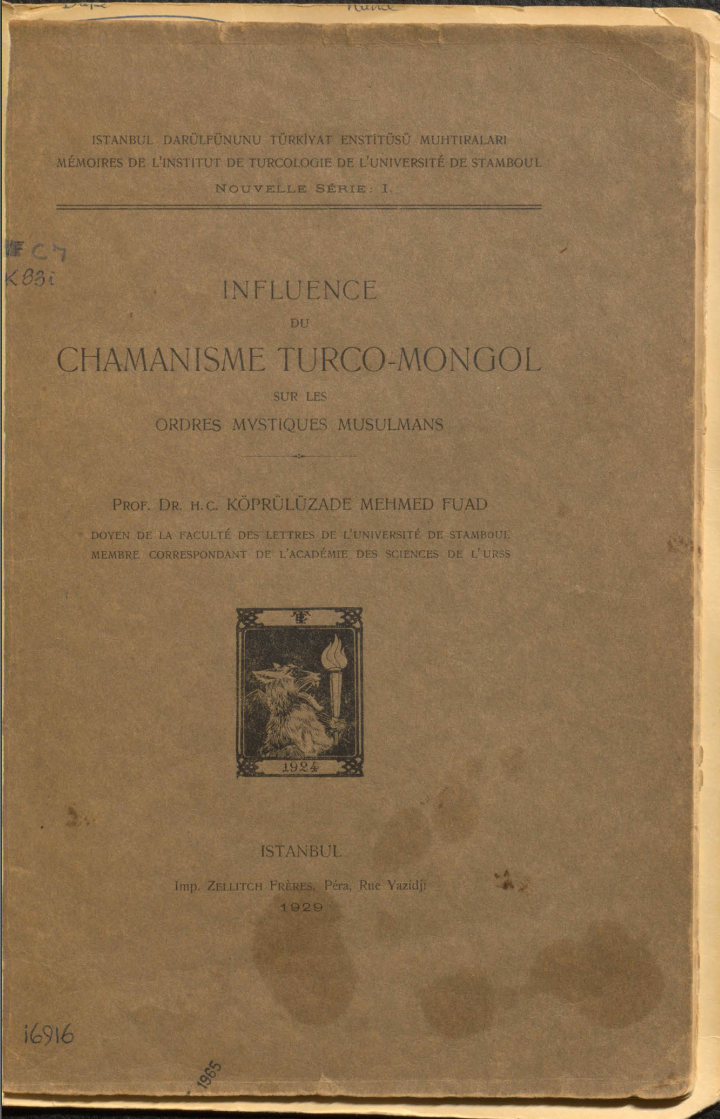
The cover of Köprülü’s Influence du chamanisme turco-mongol sur les ordres mystiques musulmans (Köprülü 1929). SOURCE: Internet Archive.
Try as I might, I cannot wrap my head around Badea’ apodictic belittlement of my work. Köprülü’s Influence du chamanisme turco-mongol sur les ordres mystiques musulmans (Köprülü 1929) is the very first Eliadean reference on shamanism included in his 1933 thesis (Ambasciano 2014: 385, 388), and the Turkish scholar’s works would be constantly cited by Eliade until the first edition of Le chamanisme et les techniques archaïques de l’extase (Eliade 1951), providing at the same time the testing ground for Eliade’s first armchair forays into Eurasian shamanism (as seen from an Interwar perspective that privileged topics such as the spiritual importance of protohistoric ethnic substrate), the mastery of paranormal powers, and the mythicization of historical events. The unavailability of Köprülü’s works in Romanian even prompted a frustrated Eliade to pen a newspaper article entitled “Let’s Learn Turkish!” (Să învăţăm turceşte, published on 28 August 1933 in Cuvîntul; Ambasciano 2014: 384-392).
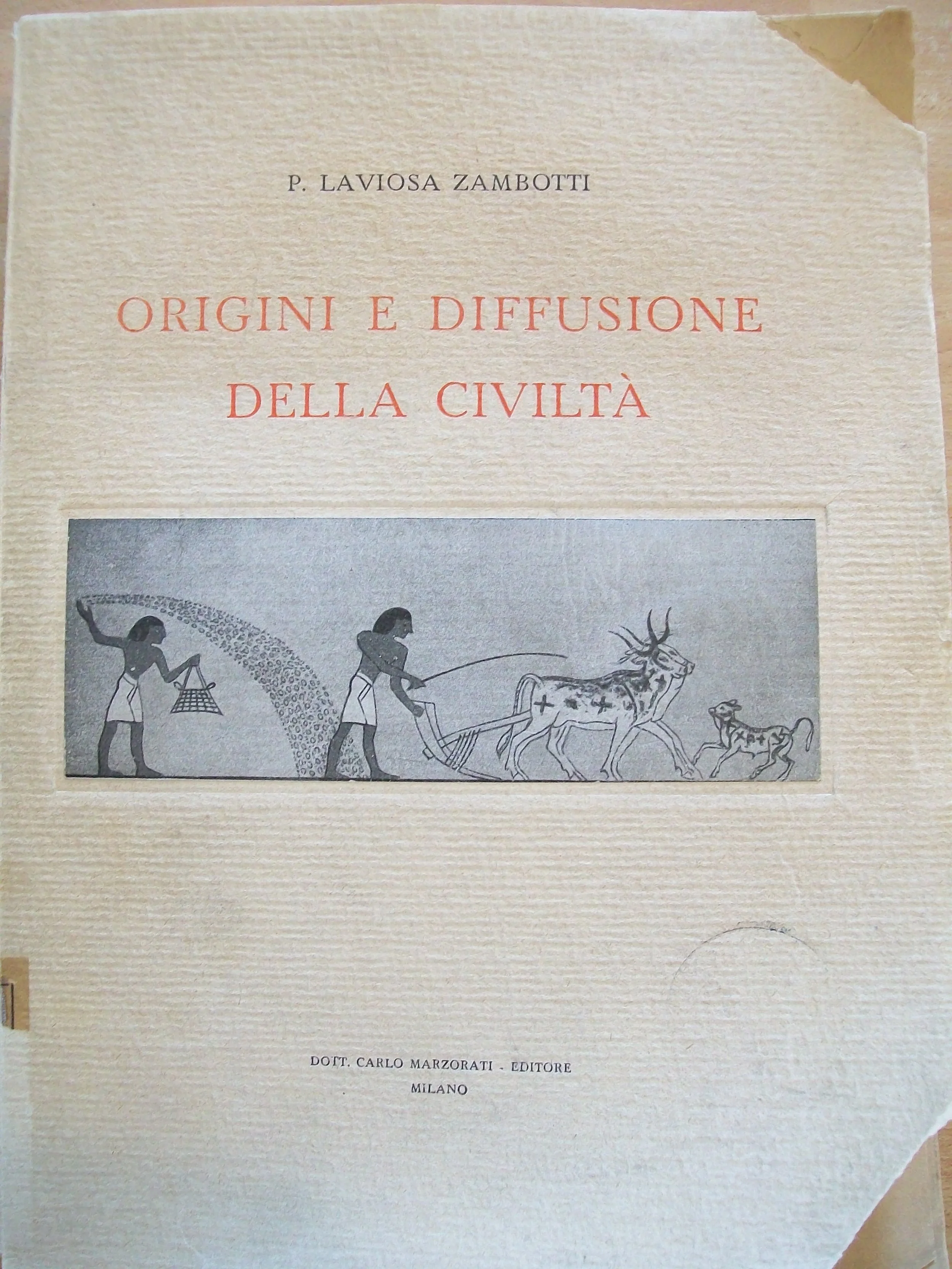
Cover of Laviosa Zambotti’s magnum opus (Laviosa Zambotti 1947). SOURCE: archival photograph from my personal collection.
As to Laviosa Zambotti, Eliade reviewed her magnum opus, Origini e diffusione della civiltà (Laviosa Zambotti 1947), and wrote the Preface to the French edition of her book (published in 1949): Laviosa Zambotti’s research programme, while since falsified, served as the post-war, Schmidtian, and diffusionist palaeoanthropological canvas upon which Eliade collaged, patchwork-style, his geo-spiritual and proto-historical interpretation of shamanism along with his Interwar beliefs about “primitive” human races as living fossils and repositories of ancient paranormal powers (especially in the first edition of his Chamanisme monograph, later heavily revised for the postwar American readership; Eliade 1964; cf. Ambasciano 2014: 126, 222). Eliade’s own words from his 1948 French review of Laviosa Zambotti’s work, should suffice to rebuke Badea’s baffling opinion:
“Laviosa Zambotti has the great merit of having fulfilled the wish of all the ‘historicist’ ethnologists, from Graebner to Hocart and W. Schmidt, of writing a universal history of humanity from the Stone Age to the present day; moreover, she did it from a perspective that might only suffer very minor criticism” (Eliade 1948).
When Eliade slapped Laviosa Zambotti on her wrist in the same review, it was only to underscore that, with a little more philosophical audacity, her volume might have truly become an “epoch-making book, basically what Spengler’s Untergang was on the verge of becoming for the Interwar generation” (Eliade 1948; my emphasis; see Ambasciano 2014: 181-248).
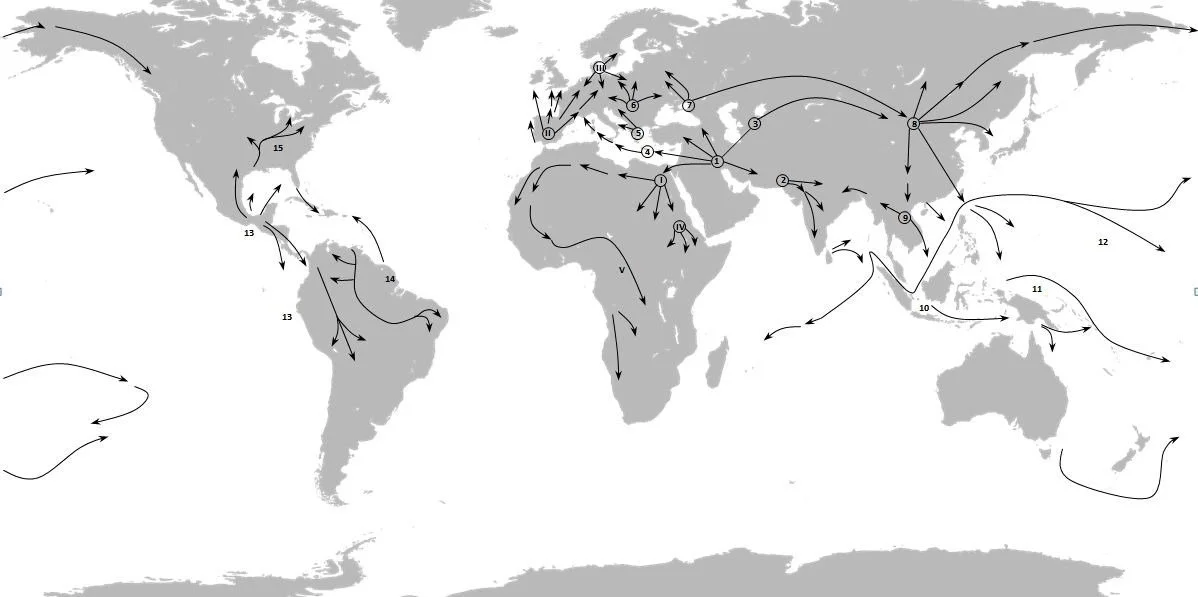
The diffusion of agricultural civilisation from a single point of origin according to Laviosa Zambotti. It should be noted that this thesis has since been falsified, as agriculture developed independently at more than a dozen sites worldwide. More info about Laviosa Zambotti’s thesis is available here. LEGEND: I. Egyptian centre of origin; II. Derived Iberian centre; III. Derived Nordic centre; IV. Derived Nubian centre; V. Congolese-Guinean ethnographic culture; 1. Babylonian-Elamite centre of origin; 2. Derived Indus centre; 3. Derived Trans-Caspian centre; 4. Derived Aegean centre; 5. Derived Balkan centre; 6. Derived Central European centre; 7. Derived Caucasian centre; 8. Derived Chinese centre; 9. Derived Indochinese centre; 10. Indonesian ethnographic sphere; 11. Melanesian ethnographic sphere; 12. Polynesian ethnographic sphere; 13. Aztec-Inca ethnographic sphere; 14. Amazonian ethnographic sphere; 15. Mississippian ethnographic sphere. Reworked from Laviosa Zambotti 1947: map no. 1, illustrated plates outside the main text. Map from Wikimedia Commons, modified. Author’s work, 2016. CC BY-NC-ND 4.0.
It is quite ironic then to read Badea’s perplexing judgement about the allegedly unimportant role of such authors in Eliade’s pre- and postwar Weltanschauung when he himself assigns an unsupported “exaggerated importance” to Italian writer Giovanni Papini (1881-1956), one of the young Eliade’s most cherished literary authors, insofar as Eliade’s anti-modernism in his entire production is concerned (cf. Scagno 1987: 167-168; Ţurcanu 2003: 66-68, 71, 154, 156, 338). As Badea writes with a touch of distasteful and passive-aggressive gaslighting to obfuscate his own lack of sufficient archival work and documentary evidence:
“in my opinion, one of the sources of Eliade’s anti-modernism could be Giovanni Papini […], but I have not found any work that might confirm such a hypothesis. Regrettably, in Italy today Papini is a forgotten author, and his works are no longer published and studied, so I have not been able to find a basis for my working hypothesis” (353).
Intermezzo: Italian dilettantism
Badea’s insufficient critical awareness should probably be assumed as unproblematic for a book that, according to Badea’s own words, is more akin to an artistic-esoteric endeavour full of overly emphatic descriptions and scathing opinions (a “hermeneutic journey”, parcur[s] hermeneutic; 35) than a serious work of historiography, insofar as only Badea’s interpretation is valid and all the others’ research results are wrong, except for a carefully circumscribed group of like-minded authors (a typically Eliadean example of the Ishmael effect combined with double standard, group conformity, and truth by authority) (cf. Ambasciano 2018: 290).
In any case, a cursory examination of Badea’s analysis of a few key Italian scholars’ works and viewpoints should be enough to expose the many disconcerting blunders and blatant historical falsities found in his book. One instance that is particularly mind-boggling is the factoid according to which Romania was never part of Mitteleuropa (România nu a aparţinut niciodată Mitteleuropei; 222; see Câstorcea 2023: 130). Such a bewildering and easily falsifiable statement is specifically advanced to downplay Furio Jesi’s (1941-1980) assessment of the intellectual convergence between Eliade’s mindscape and the Legionary movement’s ideology. According to Jesi, the influence of Central European, anti-Semitic, and anti-rationalist culture played a considerable role in this process of cultural interplay and alignment, which mirrored the reception of German intellectuals and their works within the Romanian élites before and during the Interwar period (Jesi 2011: 33-39; cf. Spineto 2006: 69; see also Corbea-Hoișie and Gräf 2023). Badea’s counterargument first deploys the baffling factoid recalled above and then exposes the highly speculative nature of Jesi’s identification of certain conceptually inverted Kabbalistic ideas mixed with Romanian folkloric themes thought to be behind Eliade’s own interpretation of the Legion’s anti-Semitism and assassinations, purportedly intended as a founding ritual for the new ethnonationalist state (ideas allegedly survived but conveniently camouflaged in Eliade’s postwar production; Jesi 2011: 68-72). However, Badea conveniently ignores the fact that Jesi’s conjectural reconstruction ultimately proved to be not too wide of the mark [8], accepts at face value Eliade’s own “stupefied” testimony according to which he never actually held such “convictions” (convingeri pe care nu le-a avut niciodată; 223), and opts to decry Jesi’s entire approach as a questionable “hermeneutic merry-go-round” (carusel hermeneutic) set in motion by his “interpretive intoxication” (beţi[e] interpretativ[ă]) concerning Eliade’s “presumed” ultranationalistic and esoteric beliefs (223). According to the Romanian scholar, Jesi’s petty and conspiracy-like goal was the “eliminat[ion of] Eliade from the Nobel Prize shortlist” (223; cf. Ambasciano 2019: 93-116, and 188, note no. 2) [9]. While Jesi assigned a disproportionate influence to certain hypothetical sources – an approach fuelled in the first place by both the scarcity of primary documents available at that time and Eliade’s reluctance, lies, and denial – this does not detract in the least from the Italian scholar’s then groundbreaking interpretation of the legionary ultranationalistic mysticism and mythopoesis within (A) the context of coeval Romanian anti-Semitism and (B) Eliade’s own intellectual fascination for both Western radical-right esotericism and the re-invented protohistory of Romanian spirituality (221-222; see Ambasciano 2014: 36, 298, 357-358, and Merlo 2003: 532-539, 581-583). When charitably judged in its entirety, misleading claim about Central European geopolitics and culture included, Badea’s counterargument features a sequence of questionable or incorrect assertions fatally suffering from logical fallacies (argument from authority, ad hominem attacks, presentism). The apologetic intent behind Badea’s rhetorical and post-truth strategy becomes obvious when, some pages later, he suggests that Eliade was neither morally irresponsible nor a “real” legionary via a textbook example of the No True Scotsman fallacy (228-229), a move that is rather understandable as an attempt to overcontextualise the political and historiographical circumstances to minimise the role and impact of Eliade’s intellectual or ethical positions. Given that the latter are always framed as more nuanced or more complex than what researchers have managed to understand so far, it looks like that Badea fell again into the trap of whataboutism (cf. Manera 2012: 129-130, and Manera 2018: 245-247; see also Ambasciano 2014, Ambasciano 2019, Lincoln 2023; for an overview of the history of the Romanian state see Schmitt 2018).
After Jesi, it is Vittorio Lanternari’s turn to stand trial (1918-2010). Lanternari is accused of advancing a “repetitive circular reasoning, deprived of any objectivity” (224) insofar as Eliade’s authorship of the 1937 article entitled Why I Believe in the Victory of the Legionary Movement (Eliade 1937 in Handoca 2001: 63-66) is concerned, and whose paternity Badea denies again via truth by authority (in this case, Ioan Petru Culianu’s and Sorin Alexandrescu’s) – even though, as Bruce Lincoln has recently underscored, “there is virtually nothing in the [1937] ‘Why I Believe…’ article that Eliade had not said in his other legionary pieces” and despite the fact that Culianu himself later recanted his views (see Lanternari 1997: 353-354; cit. from Lincoln 2023: 59; Lincoln’s book also offers a painstaking semiotic and structural analysis of this and other controversial Eliadean articles whose English translation was vetoed by Alexandrescu; see Lincoln 2023: 6). Additionally, Badea wrongfully assumes that Eliade “never lowered himself to use a straightforward political jargon” (niciodată nu a coborât la nivelul limbajului pur politicianist; 225) – a redefinition that leaves enough wiggle room for plausible deniability – despite Eliade’s career in politically engaged radical-right tabloid newspapers and occasional frankly political works like his apologetic pamphlet on Portuguese ultranationalist dictator António de Oliveira Salazar (1889-1970) (Eliade 2007: 7-218; cf. Ambasciano 2014: 301, 357, 478, 410-411). Indeed, the slew of documentary support in favour of the Romanian ultranationalist movement by Eliade is conveniently downplayed time and again in Badea’s book (for a quick glance at the vast bibliography on the matter see Ambasciano 2014: 274-281, in part. 278-279). Instead of focussing his attention on the incontrovertible data at hand, Badea resorts to gaslighting and presentism (again) as he anachronistically reproaches Lanternari for his ignorance, superficiality, and alleged inability to understand the history of Romanian ultranationalism in a time when knowledge of the Eliadean Interwar production was still sketchy at best. As a matter of fact, it is quite difficult to approach and study material that the author himself disavowed or denied having written, in an effort to control the narrative around his own production, and that an entire industry of faithful followers has continued to manipulate or conceal after his death (225).
While Cristiano Grottanelli (1946-2010) gets a slap on the wrist because his research about the relationship between Eliade and French esotericist René Guénon presumably failed to bring anything new to the table (211), it is his colleague Alfonso M. Di Nola (1926-1997) the one who gets the short end of Badea’s stick. Di Nola, guilty of having published the very first article denouncing Eliade’s anti-Semitism and legionary roots (Di Nola 1977), is vigorously criticized for his “dilettantism” as well as for his materialistic and Marxist approach to religion (214). Unfortunately for Badea’s argument, the ill-chosen bibliographical weapons of choice turn out to be two red herrings and a courtier’s reply. The red herrings involve the citation of both a totally unrelated short memoir by the late Di Nola to show his ideological hostility against Eliadean HoR (Di Nola 2007) and a harsh review by Angelo Brelich dedicated to one of Di Nola’s very early works, La visione magica del mondo. Saggio di filosofia della religiosità (“The Magical Vision of the World: An Essay on the Philosophy of Religiosity”), written between the age of 18 and 20, as tentative proof of Di Nola’s alleged amateurishness (Brelich 1953-1954). Badea’s double standard prevents Eliade’s early works from being subjected to any similar criticism, and in his apologetic zeal the author becomes plus royalist que le roi. As a matter of fact, Badea’s charge of dilettantism against Di Nola contradicts Eliade’s own positive assessment of Di Nola’s erudition and vast competences despite their antithetical epistemological positions (Eliade 1973). Ironically enough, Eliade himself considered Di Nola’s La visione magica del mondo, a juvenile work which Di Nola later disavowed as “sloppy, imbued with both a naïve vision and irrational motivations”, as “full of new insights, scholarly, and always interesting” (riche en aperçus nouveaux, érudit et toujours interessant) (Bellotta 2000: 74).
As to Badea’s deployment of the courtier’s reply, Di Nola would have stained himself with the grave offense of relying on the (in)famous Toladot dossier, an Israeli collection of documents pertaining to Eliade’s involvement with the Romanian Legion published in 1972 by Theodor Lavi (né Löwenstein) (214-216). In his indignation against Di Nola, Badea stoops so low as to deprive of any credibility the main source behind the Toladot dossier, that is, by scathingly criticizing the personal diary of Romanian writer of Jewish descent Mihail Sebastian (né Iosif Hecter; 1907-1945) as an untrustworthy, resentful, and dishonest collection of “caricatured figures” (215-216) [10]. Badea doubles down by denying any artistic or documentary value to Sebastian’s journal which, in his opinion,
“except for the reproduction of numerous love adventures and the deplorable atmosphere of World War II, fails to constitute the expression of an independent thought, of adherence to a specific intellectual tradition [în afară reproducerii numeroaselor aventuri amoroase, apoi a atmosferei deplorabile din perioada războiului, Jurnalul nu constituie expresia unei gândiri autonome, adeziunea la o anumită tradiţie intelectuală]”,
insofar as it reports only anecdotes and negative second-hand information about Eliade by common acquaintances (216). It strikes me that in Badea’s Bizarro world Sebastian’s literary works and memories are scolded with such vitriolic severity, while in our real world The Guardian, for instance, has acknowledged Sebastian’s novel For Two Thousand Years as “one of the foremost chronicles of the rise of Nazism in Europe” and praised Sebastian’s “scrupulously accurate entries in Journal 1935-1944” (Bailey 2016).
In light of all this, the fact that my work is basically denied entry in the hallowed halls of Eliadology is largely offset by the fact that I apparently find myself in the good company of such “dilettanti” as Jesi, Di Nola, Lanternari, and Grottanelli – all scholars allegedly guilty of the crime of Eliadean lèse-majesté.
Ghosting
A final reflection by Badea concerning my monograph relates to the fact that, according to him,
“the topics of shamanism and magical powers intertwine to a relative extent [se întrepătrund într-o măsură relativă], and both have a somewhat ambiguous status [un statut uşor ambiguu] given that they are located at the border between the comparative history of religions and anthropology” (117).
I contend that such a comment is sufficient evidence that Badea failed to engage fully with my book: far from revealing a merely “relative” and “ambiguous” relationship, Eliade’s works on shamanism are the culmination of the Romanian historian of religions’ lifelong interest for Traditional perennialism, esoteric “primitive” survival and modern-day restoration of lost paranormal powers, the supernatural, and pseudoscientific evolutionism (Ambasciano 2014: 110; see also Ambasciano 2018, and Ambasciano 2019: 105-116). Interestingly, a similar conclusion has also been independently suggested by Mark Sedgwick in his recent book Traditionalism: The Radical Project for Restoring Sacred Order (Sedgwick 2023: 58, 64, 360).
Since Badea seems to be under the false impression that such topics are not comprehensively treated in my book (despite their central importance in it), he abruptly stops his overview of my volume, never to be recalled again except for a single footnote (154, note no. 64) [11]. Therefore, I feel quite justified in ending just as abruptly my riposte to his baffling Bizarro overview of my Sciamanesimo senza sciamanesimo, limiting myself to note that Casadio’s introduction is confirmed as being rhetorically overblown and, even on a charitable reading, utterly questionable. As far as I’m concerned, Badea’s careless appraisal of my volume lays bare the limitations of his grasp of the subject matter – limitations that cast doubt on the reliability of his treatment of other issues in the book.
Conclusion: The “perfect imperfect duplicate” of the scientific and historical study of religion(s)
In Alan Moore’s celebrated swan song of the Silver Age Superman entitled Whatever Happened to the Man of Tomorrow, illustrated by Curt Swan and George Pérez and originally published in two parts in Superman #423 and Action Comics #538 (September 1986), Bizarro goes on a devastating and illogical rampage in both his home world and Metropolis, just to prove Superman that he is, in his backward jargon, the “perfect imperfect duplicate”. As Bizarro holds close to his chest a piece of blue kryptonite “for good luck” (which he should stay away from since that is his fatal weakness) he finally dies at the feet of a dumbfounded Superman (Moore 2006: 170-171).
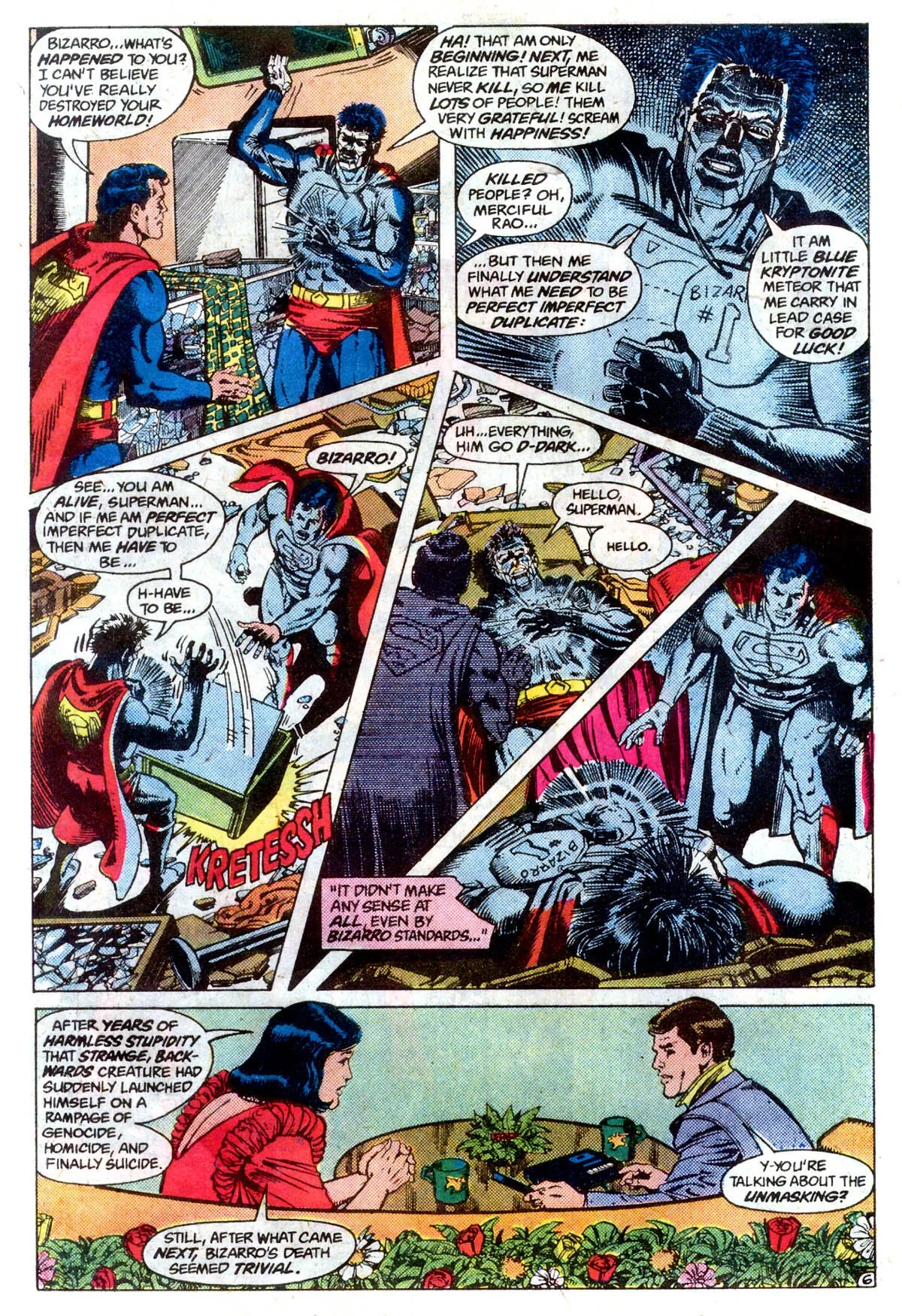
“It didn’t make any sense at all, even by Bizarro standards…”. Bizarro’s self-destructive rampage in Superman #423. SOURCE: Tom Brevoort’s blog. © DC Comics.
In his book, Badea showcases the exact opposites of the professional qualities that a historian should strive to master, including a disconcerting dismissiveness with regards to any documentary evidence or interpretation that could undermine or contradict his entrenched Eliadological viewpoint (Sagan 1997: 242). At the same time, Badea relentlessly engages in a tu quoque projection of his own biases onto his opponents, along with the magnification of their less relevant mistakes and the minimisation of Eliade’s own responsibilities, which results in a typically Eliadological slothful induction never to be satisfied by any cumulative evidence or smoking gun. Even so, Badea’s claims are epistemically unwarranted because, according to contemporary non-Bizarro historiography and the current state of the art in Comparative Fascist Studies, the ultranationalist, mystical, and racist/racial nature of both the Legion and Eliade’s own intellectual roots, Eliade’s original design for HoR as the ethnonationalistic instrumentum regni of a new Romanian nation, as well as his postwar metapolitical transformation of HoR into a “saving discipline”, all remain intact (Ambasciano 2014: 301, 408; Ambasciano 2018: 289; Ambasciano 2019: 119-120).
Badea’s pseudohistoriographical rampage, contextualised within a minor Eliadology-friendly disciplinary revival that has been distinguishing itself for the fabrication of fringe, epistemically unwarranted, or patently false academic claims [12], exemplifies the current crisis of a backward sub-discipline that might finally be in its death throes because of the unrepentant adoption of historiographical revisionism, presence of incorrigible biases and prejudices, and absence of clear epistemological directions. It is a destiny that the phenomenological and hermeneutic HoR – the “perfect imperfect duplicate” of the scientific and historical study of religion(s) – brought upon itself by holding close to its chest the kryptonite relics of the long-dead, Interwar Weltanschauungen of Eliade and his colleagues.
Notes
[1] This post is the expanded version of a commentary published in Studi e Materiali di Storia delle Religioni 91(2) 2025: 753-787. I would like to thank Enrico Manera, Bruce Lincoln, and Sergio Botta for enduring with resigned patience my dogged determination to proceed with the writing of this commentary despite their sincere and heartfelt attempts to spare me further disciplinary headaches. Their help and many useful suggestions proved invaluable. It goes without saying that all the opinions (as well as any mistake) herein expressed is mine alone.
[2] The Italian pioneer in the History of Religions is elsewhere misnamed by Badea as “Raffaelle Pettazzoni”; see Badea 2022: 11, 36.
[3] Curiously, the same historiographical modus operandi was highlighted as normal and necessary by Giovanni Casadio himself, one of Badea’s Italian disciplinary masters (see, for instance, Badea 2022: 13). In particular, Casadio wrote that “the conditioning factors that operate in the microhistory of individual intellectuals is no less powerful, even if less documented and perceptible, than those operating in the macrohistory of peoples. If one avoids superficial, unilateral, and tendentiously reductive approaches [...] the investigation into the intimate history of those who write history [...] is not only authorized but necessary to read and understand from within the works of the great scholars who promote hermeneutical trends and ultimately create cultural fashions” (Casadio 2002: 18; see Ambasciano 2014: 33). The fact that, despite our unbridgeable research approaches and radically different ethical stances, Casadio and I are somewhat in agreement about this important methodological and historiographical point is enough to show the extent to which Badea is wrong.
[4] At the time of writing, I did not consider my partial knowledge of Foucault’s thought sufficient to justify including his works, and I also questioned their relevance to that particular historiographical context. However, I did include Foucault’s works where I thought they were epistemologically pertinent, that is, when dealing with power dynamics in my PhD dissertation on gender and sexuality in ancient history.
[5] Indeed, Badea’s nil nisi bonum approach leads him to condemn those scholars in Romania, like Florin Ţurcanu, and in Italy, like those we will encounter later on, who “dishonourably” disrespected the epistemological value of Eliade’s works through simple critical examination (este dezonorant să calomniezi pe cineva aflat în imposibilitatea fizică de a se apăra după moartea sa; 228-229).
[6] Interestingly, Badea carefully avoids levelling such inconsistent accusation against other tomes of similar “prolixity” but that are, rather conveniently, probably more Eliadologically sympathetic in terms of politics, anti-scientism, beliefs in culturally postulated superhuman beings, the supernatural, or the paranormal.
[7] See, for instance, Eliade’s understanding and re-elaboration of Emil Racoviţă’s living fossils and orthogenesis, Constantin Rădulescu-Motru’s personalistic neocreationism, Bogdan Petriceicu Hasdeu’s neocreationist and spiritualistic philosophy of history, Lucian Blaga’s saltationism, Nae Ionescu’s racist and Orthodoxist ultranationalism, Vasile Conta’s racist philosophy, Jagadish Bose’s proto-panpsychistic minerals and plant research, C. G. Jung’s collective unconscious and racial archetypes, Teilhard de Chardin and Lecomte de Noüy’s Intelligent Design, the conspiritual and panpsychist hoax known as “Princeton Gnosis” which Eliade fell for, and a curious mix of esoteric and fringe anthropological speculations about Asia and Australasia as the prehistoric cradle of humankind with the existence of protohistorical evolutionary stages of paranormal powers (Ambasciano 2014: 82, 89-98, 125, 192-197, 260-268, 270, 271-274, 274-280, 281-282, 284-286, 286-289, 289-304).
[8] In 1978 Eliade himself would produce an astonishing emic interpretation eerily similar to Jesi’s; see Manera 2018: 246 on Eliade 1982: 127.
[9] By that time Eliade had already been nominated twice, and twice ignored, for the Nobel Prize in Literature: in 1957 by Professor of Albanian Literature at Sapienza Università, Rome, Ernest (Ernesto) Koliqi, and in 1968 by Professor of Sanskrit and Indo-European languages at Uppsala University, Sweden, Stig Wikander; see Nomination Archive, NobelPrize.org, Nobel Prize Outreach AB 2024, https://www.nobelprize.org/nomination/archive/show.php?id=16607, https://www.nobelprize.org/nomination/archive/show.php?id=20352 [Last Accessed 01 March 2024].
[10] Philosopher, ultranationalist pundit, and Mircea Eliade’s mentor Nae Ionescu (1890-1940) is among those figures, as he wrote an anti-Semitic, “venomous introduction” to Sebastian’s 1934 novel For Two Thousand Years (Sebastian 2016); cit. from Weber 2001. In any case, the relationship between Ionescu and Sebastian was much more tormented and problematic than Badea assumes it to be; cf. Petreu 2009 and Idel 2014: 193-212; on Ionescu see Ambasciano 2014: 260-268; on the Toladot dossier see Ambasciano 2014: 117-119.
[11] For instance, Badea’s analysis of Eliade’s literary production fails to take into account my extended cross-disciplinary examination of exactly the same topic; e.g., Ambasciano 2014: 97-98, 392-406, 423-470.
[12] Cf., for instance, Eliade as a pioneer of the cognitive science of religions, as a forerunner of postmodernism, or as the trailblazer of a paradigm shift according to which HoR should unashamedly become some sort of metahumanistic Paranormal Studies à la X-Files (resp., Rennie, 2017; Rennie 2020; Kripal 2011: 187-208, and Kripal et al. 2014; cf. Ambasciano, 2021c).
Refs.
Alciati, Roberto. 2022. “Religione e violenza. Alcune considerazioni su una coppia spesso impensata.” In Violenza sacra. 2. Guerra santa, sacrificio e martirio in età contemporanea, a cura di M. Paiano, 29-45. Rome: Viella.
Ambasciano, Leonardo. 2014. Sciamanesimo senza sciamanesimo. Le radici intellettuali del modello sciamanico di Mircea Eliade: evoluzionismo, psicoanalisi, te(le)ologia. Rome: Nuova Cultura.
Ambasciano, Leonardo. 2015. “Mapping Pluto’s Republic: Cognitive and Epistemological Reflections on Philosophy of Pseudoscience: Reconsidering the Demarcation Problem.” Journal for the Cognitive Science of Religion 3(2): 183-205. https://doi.org/10.1558/jcsr.27091
Ambasciano, Leonardo. 2017. “What Is Cognitive Historiography, Anyway? Method, Theory, and a Cross-Disciplinary Decalogue.” Journal of Cognitive Historiography 4(2): 136-150. https://doi.org/10.1558/jch.38759
Ambasciano, Leonardo. 2018. “Politics of Nostalgia, Logical Fallacies, and Cognitive Biases: The Importance of Epistemology in the Age of Cognitive Historiography.” In Evolution, Cognition, and the History of Religion: A New Synthesis, edited by A. K. Petersen, G. I. Sælid, L. H. Martin, J. S. Jensen, and J. Sørensen, 280-296. Leiden and Boston: Brill. https://doi.org/10.1163/9789004385375_019/
Ambasciano, Leonardo. 2019. An Unnatural History of Religions: Academia, Post-truth, and the Quest for Scientific Knowledge. London and New York: Bloomsbury.
Ambasciano, Leonardo. 2020a. “Memoirs of an Academic Rōnin: Religious Studies and Mentorship in the Age of Post-Truth.” Method & Theory in the Study of Religion 33(1): 1-20. https://doi.org/10.1163/15700682-12341495
Ambasciano, Leonardo. 2020b. “The Sisyphean Discipline: A Précis of An Unnatural History of Religions.” Religio. Revue Pro Religionistiku 28(1): 3-20. http://hdl.handle.net/11222.digilib/142823 (expanded version published in in D. Wiebe (2021), An Argument in Defence of a Strictly Scientific Study of Religion: The Controversy at Delphi, 75-101. Toronto, ON: Institute for the Advanced Study of Religion).
Ambasciano, Leonardo. 2021a. “The Deafening Silence of Religious Studies.” In Deep Times: History and Science Shaken, Not Stirred, 8 February, https://www.leonardoambasciano.com/blog/the-deafening-silence-of-religious-studies [Last Accessed 13 February 2026].
Ambasciano, Leonardo. 2021b. “The Trials and Tribulations of Luke Skywalker: How The Walt Disney Co. and Lucasfilm Have Failed to Confront Joseph Campbell’s Troublesome Legacy.” Implicit Religion 23(3): 251-276. https://doi.org/10.1558/imre.43229
Ambasciano, Leonardo. 2021c. “An Evolutionary Cognitive Approach to Comparative Fascist Studies: Hypermasculinization, Supernormal Stimuli, and Conspirational Beliefs.” Evolutionary Studies in Imaginative Culture 5(1): 23-39. https://doi.org/10.26613/esic.5.1.208
Ambasciano, Leonardo. 2025. “Absolutely Disruptive: An Introduction to Josephson Storm’s Metamodernism Book Review Symposium.” Method & Theory in the Study of Religion 37(1): 1-12. https://doi.org/10.1163/15700682-bja10134
Ambasciano, Leonardo (forthcoming). “Cognitive Science of Religion, Cognitive Historiography, and Ancient Mystery Cults.” In The Oxford Handbook of Ancient Mystery Cults, edited by H. Bowden and A.-I. Rassia (xxx-xxx). Oxford: Oxford University Press.
Angelini, Pietro. 2001. L’uomo sul tetto. Mircea Eliade e la “storia delle religioni”. Turin: Bollati Boringhieri.
Angelini, P. (ed.). 2020. Cesare Pavese, Ernesto De Martino: La Collana Viola. Lettere 1945-1950. Nuova edizione rivista e aggiornata. Turin: Einaudi.
Arcari, Luca e Alessandro Saggioro (2015). “Introduzione.” In Sciamanesimo e sciamanesimi. Un problema storiografico, edited by L. Arcari and A. Saggioro, 7-24. Rome: Nuova Cultura.
Badea, Gabriel. 2022. Mircea Eliade, între tradiţionalism şi modernism. Posteritatea critică în Italia. Bucharest: Editura Universităţii din Bucureşti.
Bailey, Paul. 2016. “‘I Am Ashamed to Be Sad’: The Remarkable Story of A Jewish Student in 1920s Romania.” The Guardian, 19 March. https://www.theguardian.com/books/2016/mar/19/mihail-sebastian-two-thousand-years-nazism-europe [Last Accessed 14 February 2026].
Bellotta, Ireneo. 2000. “Bio-bibliografia di Alfonso M. Di Nola.” In Antropologia e storia delle religioni. Saggi in onore di Alfonso M. Di Nola, edited by A. De Spirito and I. Bellotta, 73-88. Rome: Newton & Compton.
Brelich, Angelo. 2021. “Some Notes Concerning a Congress of the History of Religions.” Transl. by Leonardo Ambasciano. In Wiebe, Don. An Argument in Defence of a Strictly Scientific Study of Religion: The Controversy at Delphi, 215-224. Toronto, ON: Institute for the Advanced Study of Religion (originally published in 1960 as “Ai margini del 10° Congresso Internazionale di Storia delle Religioni (Marburgo, 11 e 17-9-1960)”, Studi e Materiali di Storia delle Religioni 31: 121-128; republished in 1979 as “A proposito di un Congresso di Storia delle religioni” in Brelich, A. Storia delle religioni, perché?, edited by V. Lanternari, 130-136, Naples: Liguori).
Brelich, Angelo. 1953-1954. Review of Di Nola, A. M. 1954. La visione magica del mondo. Saggio di filosofia della religiosità (Modena: Guanda). Studi e Materiali di Storia delle Religioni 24-25: 282.
Boudry, Maarten and Massimo Pigliucci (eds.). 2017. Science Unlimited? The Challenges of Scientism. Chicago and London: The University of Chicago Press.
Casadio, Giovanni. 2002. “Per Ugo Bianchi. Introduzione.” In Ugo Bianchi. Una vita per la storia delle religioni, edited by G. Casadio, 9-27. Rome: Il Calamo.
Câstorcea, R. 2023. “The Unbearable Virtues of Backwardness: Mircea Eliade’s Conceptualisation of Colonialism and His Attraction to Romania’s Interwar Fascist Movement.” In East Central Europe Between the Colonial and the Postcolonial in the Twentieth Century, edited by S. Huigen and D. Kołodziejczyk, 113-140. Cham, CH: Palgrave Macmillan. https://doi.org/10.1007/978-3-031-17487-2_5
Corbea-Hoișie, A. and R. Gräf (eds.), 2023. Limbă şi cultură germană în România (1918-1933), 2 vols. Iaşi: Polirom.
Creech, J., P. Kamuf and J. Todd. 1985. “Deconstruction in America: An Interview with Jacques Derrida.” Critical Exchange 17(Winter): 1-32.
Cowsill, A., A. Irvine, M. K. Manning, M. McAvennie, D. Wallace, A. Dougall and C. Cerasi. 2016. DC Comics Year by Year: A Visual Chronicle. Updated Edition. London: DK.
Derrida, J. 2005. Writing and Difference. Translated with an Introduction and Additional Notes by Alan Bass. London and New York: Routledge (originally published in 1967 as L’écriture et la différence by Éditions du Seuil, Paris; first English edition published in 1978 by The University of Chicago Press/Routledge & Kegan Paul, Chicago/London].
Di Nola, Alfonso M. 1977. “Eliade e l’antisemitismo.” La Rassegna Mensile di Israel, terza serie 43(1/2): 12-15. https://www.jstor.org/stable/41284369
Di Nola, Alfonso M. 2007. Attraverso la storia delle religioni Rome: Di Renzo Editore (originally published in 1996).
Eliade, Mircea. 1948. Review of Laviosa Zambotti, P. 1947. Origini e diffusione della civiltà (Milan and Messina: Principato). Critique 29 (October): 897-908.
Eliade, Mircea. 1951. Le chamanisme et les techniques archaïques de l’extase. Paris: Payot.
Eliade, Mircea. 1964. Shamanism: Archaic Techniques of Ecstasy. Transl. by W. Trask. New York/London: Pantheon-Bollingen Foundation/Routledge and Kegan Paul.
Eliade, Mircea. 1973. “Dictionaries and Encyclopedias.” Review of Dictionary of Comparative Religion, edited by S. G. F. Brandon, Charles Scribner’s Sons, New York 1970; Enciclopedia delle religioni, edited by A. M. Di Nola, Vallecchi, Florence 1970-1971. History of Religions 12(3): 288-295. https://www.jstor.org/stable/1062028
Eliade, Mircea. 1982. Ordeal by Labyrinth. Conversations with Claude-Henri Rocquet. Transl. by D. Coltman. Chicago and London: The University of Chicago Press (originally published in 1978 as L’Épreuve du Labyrinthe by Belfond, Paris).
Eliade, Mircea. 2001. “De ce cred în biruinţa Mişcării Legionare. Răspunsul domnului Eliade.” In Eliade, M., Textele “legionare” şi despre “românism”, edited by M. Handoca, 63-66. Cluj-Napoca: Dacia (originally published in Buna Vestire 1, 244, 17 Decembrie 1937, pp. 1-2).
Eliade, Mircea. 2007. “Salazar şi revoluţia în Portugal.” In Eliade, M., Jurnalul portughez şi alte scrieri. Ediţia a II-a revăzută şi adăugită, edited by S. Alexandrescu, vol. 2: 7-218. Bucharest: Humanitas (originally published in 9142 by Ed. Gorjan, Bucharest).
Elden, S. 2024. “Foucault and Dumézil on Antiquity.” Journal of the History of Ideas 85(3): 571-600. https://doi.org/10.1353/jhi.2024.a933859
Ermacora, Davide. 2015. “Mircea Eliade e la realtà dei poteri paranormali.” Studi e Materiali di Storia delle Religioni 81(2): 689-757.
Ferraris, Maurizio. 2008. Introduzione a Derrida. Rome and Bari: Laterza.
Ferraris, Maurizio 2014. Manifesto of New Realism. Transl. by S. De Sanctis. Albany, NY: New York University Press, 2014 (originally published in 2012 as Manifesto del nuovo realismo. Rome and Bari: Laterza).
Ferretti, G. C. 2017. L’editore Cesare Pavese. Turin: Einaudi.
Geertz, Armin W. and Russell T. McCutcheon. 2000. “The Role of Method and Theory in the IAHR.” In Perspectives on Method and Theory in the Study of Religion. Adjunct Proceedings of the XVIIth Congress of the International Association for the History of Religions, Mexico City, 1995, edited by A. W Geertz, R. T. McCutcheon and S. S. Elliott, 3-37. Leiden, Boston and Köln: Brill.
Ginzburg, Carlo. 2010. “Mircea Eliade’s Ambivalent Legacy.” In Hermeneutics, Politics, and the History of Religions: The Contested Legacies of Joachim Wach and Mircea Eliade, edited by C. K. Wedemeyer and W. Doniger, 307-323. New York: Oxford University Press.
Gordon, Ian. 2017. Superman: The Persistence of an American Icon. New Brunswick, NJ: Rutgers University Press.
Griffin, Roger. 2018. Fascism: An Introduction to Comparative Fascist Studies. Cambridge and Medford, MA: Polity Press.
Idel, Moshe. 2014. Mircea Eliade. De la magie la mit. Iaşi: Polirom.
Jesi, Furio. 2011. Cultura di destra. Con tre inediti e un’intervista. A cura di Andrea Cavalletti. Rome: nottetempo (originally published in 1979 by Garzanti, Milan).
Josephson Storm, Jason Ā. 2021. Metamodernism: The Future of Theory. Chicago: The University of Chicago Press.
Koertge, N. 2013. “Belief Buddies Versus Critical Communities.” In Philosophy of Pseudoscience: Reconsidering the Demarcation Problem, edited by M. Pigliucci and M. Boudry, 165-180. Chicago and London: The University of Chicago Press.
Köprülü, Mehmet F. 1929. Influence du chamanisme turco-mongol sur les ordres mystiques musulmans. Istamboul: Mémoires de l’Institut de Turcologie de l’Université de Stamboul I, n.s.
Kripal, Jeffrey J. 2011. “The Future Human: Mircea Eliade and the Fantastic Mutant.” Archæus: Studies in the History of Religions 15(1-2): 187-208.
Kripal Jeffrey J., A. Anzali, A. R. Jain and E. Prophet (2014). Comparing Religions: Coming to Terms. Malden, MA: Wiley Blackwell.
Laviosa Zambotti, Pia. 1947. Origini e diffusione della civiltà. Milan and Messina: Principato (transl. by J. Gouillard and published in French as Les origines et la diffusion de la civilisation. Introduction à l’histoire universelle. Préface de Mircea Eliade. Paris: Payot).
Lincoln, Bruce. 2023. Secrets, Lies, and Consequences: A Great Scholar’s Hidden Past and His Protégé’s Unsolved Murder. Chicago and London: The University of Chicago Press.
Lyotard, J.-F. 1984. The Postmodern Condition: A Report on Knowledge. Transl. by G. Bennington and B. Massumi, Foreword by F. Jameson, Minneapolis: University of Minnesota Press (originally published in 1979 as La Condition postmoderne. Rapport sur le savoir, Les Éditions de Minuit, Paris).
Lanternari, Vittorio. 1997. Antropologia religiosa. Etnologia, storia, folklore. Bari: Dedalo.
Leach, E. R. 1966. “Sermons by a Man on a Ladder.” The New York Review of Books 7(6): 28-31. https://www.nybooks.com/articles/1966/10/20/sermons-by-a-man-on-a-ladder/ [Last Accessed 12 February 2026].
Lincoln, Bruce. 1996. “Theses on Method.” Method & Theory in the Study of Religion 8(3): 225-227. https://doi.org/10.1163/157006896X00323
Lincoln, Bruce. 2008. Gods and Demons, Priests and Scholars: Critical Explorations in the History of Religions. Chicago and London: The University of Chicago Press.
Manera, Enrico. 2012. Furio Jesi. Mito, violenza, memoria. Rome: Carocci.
Manera, Enrico. 2015a. “Sugli scritti giovanili di Furio Jesi.” In Historia Religionum 7: 125-142. https://doi.org/10.1400/235822
Manera, Enrico. 2015b. “La storia delle religioni tra politica interbellica, ontologia e scienze naturali: Mircea Eliade e la sua idea di sciamanesimo.” L’Indice dei Libri del Mese 32(7/8): 10 (a slightly revised version is available in «Doppiozero», 8 June 2015. https://www.doppiozero.com/leredita-di-eliade) [Last Accessed 12 February 2026].
Manera, Enrico. 2018. “Di ciò che non c’è. ‘Scienza del mito’ e ‘cultura di destra’ in Furio Jesi.” Studi e Materiali di Storia delle Religioni 84(1): 234-253.
Merlo, Roberto. 2003. La Dacia nella cultura romena: tra storia e mito, unpublished Ph.D. diss. Turin: Università degli Studi di Torino (partially revised, updated, and published in 2011 as Il mito dacico nella letteratura romena dell’Ottocento. Alessandria: Edizioni dell’Orso).
Petreu, Marta. 2009. Diavolul şi ucenicul său. Nae Ionescu – Mihail Sebastian. Iaşi: Polirom.
Rennie, Bryan S. 2017. “The Sacred and Sacrality: From Eliade to Evolutionary Ethology.” Religion 47(4): 663-687. https://doi.org/10.1080/0048721X.2017.1362833
Rennie, Bryan S. 2020. An Ethology of Religion and Art: Belief as Behavior. New York: Routledge.
Rowland, I. D. 2014. “Furio Jesi and the Culture of the Right.” In History of the Humanities III: The Modern Humanities, edited by R. Bod, J. Maat and T. Weststeijn, 293-310. Amsterdam: Amsterdam University Press.
Sacco, Leonardo. 2008. “Neo-sciamanesimo & New Age. Il ‘contributo’ di Mircea Eliade.” Archæus. Studies in the History of Religions 11-12: 249-304.
Scagno, Roberto. 1987. “L’ermeneutica creativa di Mircea Eliade e l’Italia.” In Mircea Eliade e l’Italia, edited by Marin Mincu and Roberto Scagno, 155-170. Milan: Jaca Book.
Schmitt, O. J. 2018. România în 100 de ani. Bilanţul unui veac de istorie. Urmat de un dialog cu Marian Voicu. Transl. by W. Tauwinkl. Bucharest: Humanitas.
Sebastian, Mihail. 2016. For Two Thousand Years. Transl. by P. Ó Ceallaigh. London: Penguin (originally published in 1934 as De două mii de anii… Roman, cu o prefaţă de Nae Ionescu. Bucharest: Ed. Naţională Ciornei).
Sedgwick, Mark. 2023. Traditionalism: The Radical Project for Restoring Sacred Order. London: Penguin.
Smith, Jonathan Z. 2001. “A Twice-Told Tale: The History of the History of Religions.” Numen 48(2): 131-146; http://www.jstor.org/stable/3270496?origin=JSTOR-pdf
Spineto, Natale. 2006. Mircea Eliade storico delle religioni. Con la corrispondenza inedita Mircea Eliade – Károly Kérenyi. Brescia: Morcelliana.
Stochino, E. 2023. “Pier Paolo Pasolini and the Sacred.” New Theatre Quarterly 39(2): 103-123. https://doi.org/10.1017/S0266464X23000052
Sokal, Alan and Jean Bricmont. 1998. Intellectual Impostures. London: Profile Books (originally published in 1997 as Impostures intellectuelles. Paris: Odile Jacob).
Ţurcanu, Florin. 2007. Mircea Eliade prizonierul istoriei. Ediţia a II-a revazută. Bucharest: Humanitas (originally published in 2003 as Mircea Eliade. Le prisonnier de l’histoire. Paris: Éditions La Découverte).
Warburton, Nigel. 2007. Thinking from A to Z. Third Edition, London and New York: Routledge.
Weber, Eugen. 2001. “You Have to Hang On.” London Review of Books 23: 22. https://www.lrb.co.uk/the-paper/v23/n22/eugen-weber/you-have-to-hang-on [Last Accessed 13 February 2026].
Wiebe, Don. 2023. The Western Epistemic Tradition and the Scientific Study of Religion. Sheffield, UK and Bristol, CT: Equinox.