

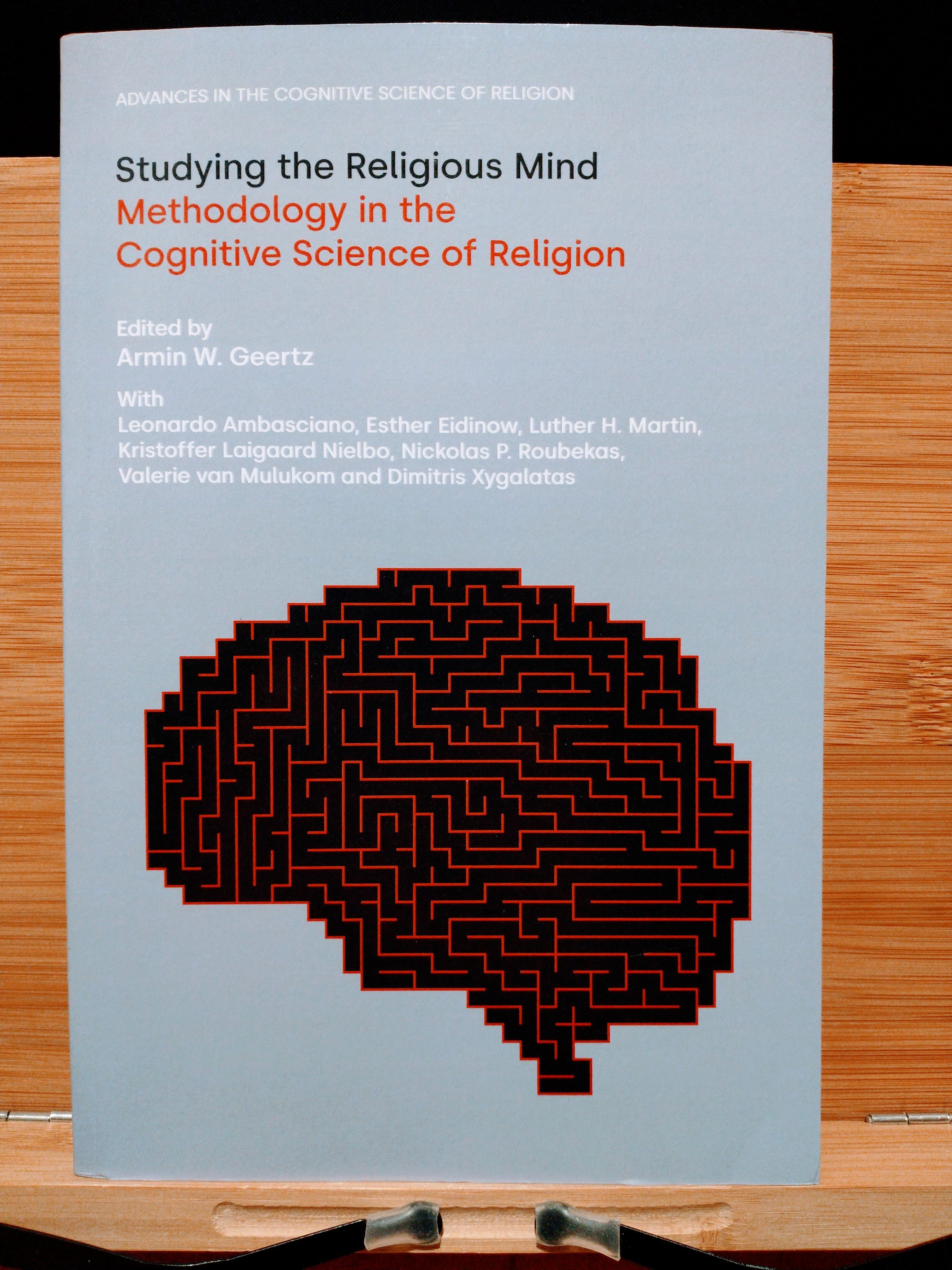
In his review of Studying the Religious Mind, Gregory D. Alles writes:
“While I agree entirely with Leonardo Ambasciano’s call to reject post-truth and folk-historical thinking (242), his chapter’s vigorous sermonizing may only alienate readers who are not in the choir. It may also have led him to the facile overstatement: ‘The more documents are available, the clearer the pictures of the past – and consequently, of the present’ (243). Really? I have been looking at accounts of massacres recently. The more documents I have, the more muddled the picture becomes, for reasons that I think are easily understood. To their credit, Benjamin Beit-Hallahmi as well as Justin E. Lane and F. LeRon Shults avoid this kind of rhetoric entirely” (Alles 2024: 177).
While I am glad to know that Alles concurs with me that “post-truth and folk-historical thinking” need to be banished from our field(s), I have to confess my discomfiture for his critical remarks – which I found rather baffling for a series of reasons that need to be unpacked to be properly understood.
Mea Culpa, or the Nasty Consequences of a Missing Abstract
First of all, the chapter, like all the pieces included in the book, was first conceived as a contribution (in this case, an editorial opening piece) to an academic journal, the Journal of Cognitive Historiography, during my tenure as Managing Editor. Said piece was born out of the frustration with precisely the same things that Alles accuses me of: a lack of interdisciplinary dialogue, the total absence of epistemologically warranted cross-disciplinary integration, and the presence of “vigorous sermonizing” that only “alienate[s] readers who are not in the choir”. A modicum of professional deontology would have motivated Alles to go and find the abstract of my original article online, which I report here in extenso to the benefit of all readers:
“This contribution offers a tentative systemization of different strands of method and theory in the sub-field of cognitive historiography in the form of a decalogue and 30 reflections. The primary aim is to clarify the role of both interdisciplinary collaboration and cross-disciplinary integration. The secondary goal is to provide interested readers, colleagues, and young researchers from a wide range of different academic branches across the two cultures with a crash course and a protocol to basic collaborative research. An indicative and essential bibliography is also provided. This introductory opinion piece is open for further comments, additions, suggestions, and discussions” (from the 2017 publication of Ambasciano 2022a).
This should be enough to properly contextualize the origins and the intended readership of my chapter.
My article, literally offered as an “Editorial Opinion Piece” to the JCH readership, was thought of as a vademecum, shaped like a tongue-in-cheek decalogue, to help students from all the different branches that converge towards the social-scientific and neurobiological study of human beliefs and behaviours; I was frustrated by the absence of such quick-and-dirty leaflets in my field, and discombobulated by the “floccinaucinihilipilification” of history and historiography perpetrated by some of the big names in the CESR (Ambasciano 2017). Therefore, I decided to poke fun at their own unapologetically scientistic shticks and adopted an extreme version of their jargon; my aim was to distil what I learned during my visiting lectureship at Masaryk University into what I believed was quite an effective and, most importantly, succint study guide, complete with a good, if incomplete, selection of basic bibliographical references. It was meant to provide a balanced middle ground between the “two cultures”, between classical humanistic approaches, including poststructuralist criticism, and cutting-edge scientific tools to counteract the CESR’s appalling ignorance of historiographical method and theory. That’s all.
I deeply regret now not having included a reworked version of the abstract in the published chapter.
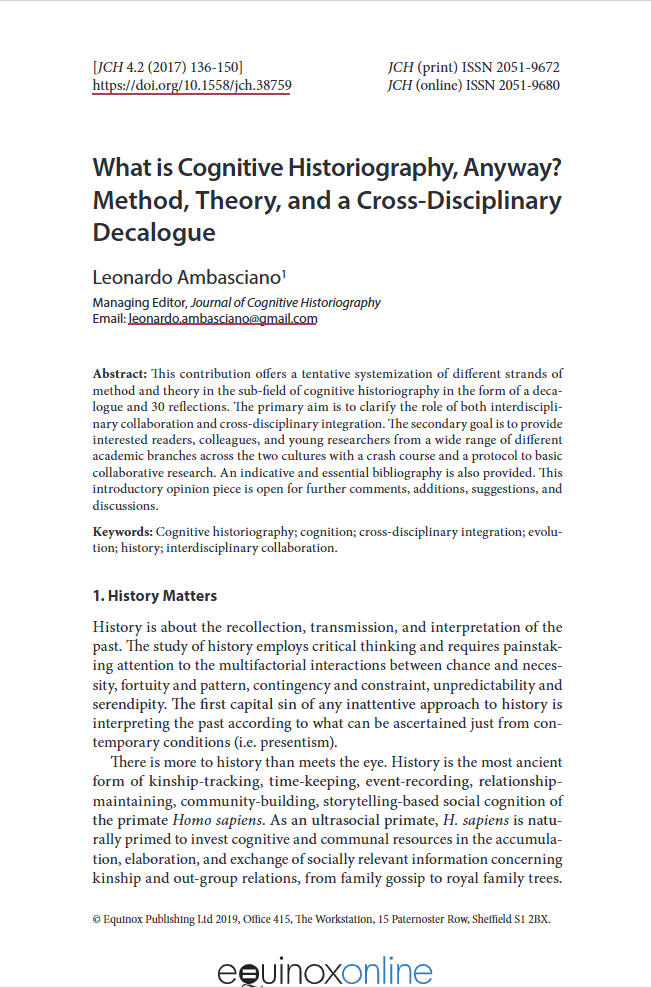
See? That wasn’t difficult to find online, was it? SOURCE:Journal of Cognitive Historiography.
In any case, the feedback I got was very good, both from colleagues with scientific credentials and from those with a more humanistic pedigree. In my own book, and despite Alles’ opinion, that was by any means no small feat, and I’m still rather proud of my “decalogue”. One colleague even wrote to me the following:
“[…] what a pleasure! I have almost no comments or suggestions, other than praise. […] It’s a wonderful, synoptic, authoritative essay – the kind of text I’ll be sharing enthusiastically with students and colleagues […]! I have never come across such a comprehensive overview before, and never realized that I needed it. […] So, thank you for sharing this with me. It really is an excellent, important essay”. [1]
My own “field” experience with the article is very good too: everyone I asked found it eye-opening it terms of interdisciplinary collaboration. Also, the fact that, mutatis mutandis, the groundbreaking metamodernistic movement is currently going in the very same direction, shows that my piece had the finger on the (cross)disciplinary pulse and its epistemological heart in the right place (see Josephson Storm 2021; Ambasciano 2024a). My sample is obviously statistically insufficient to draw any definite conclusions, but it’s still larger than Alles’ personal opinion: only a scholar out of touch with the current trends in the field would label my decalogue as a “vigorous sermonizing [that] may only alienate readers who are not in the choir”. Given the (admittedly informal) reception of my chapter, which “choir” at risk of being alienated is Alles talking about here? The Eliadological one? The classical phenomenological one? The theological one? The spiritualistic one? We don’t know because Alles is apparently beyond providing clear references. In any case, these “choirs” were never even part of the conversation in the first place – as I believe they are not epistemologically warranted approaches (see Ambasciano 2019).
More documents, more problems?
By his own admission, Alles’ academic formation is rooted in philology with a more recent anthropological emphasis, while his qualifications to write about CSR, as he himself present them, seem a bit more dodgy:
“my training is in Greek, Roman, and Sanskrit philology, but for some time now I have been working with Adivasis (tribal people) in contemporary western India. I have followed work in CSR off and on since, at the latest, a stimulating conversation with Stewart Guthrie during a flight in 2000” (Alles 2021-2023: 175).
Alles then confesses his sympathy towards CSR, “because the natural sciences and mathematics were [his] first intellectual loves”, recalls an interesting but methodologically ill-thought and ultimately abandoned poll he carried out in India, and finally adds more names to the list of more or less direct “personal relationships” with researchers in this area along with a recent remote, “small-group” academic collaboration “devoted to [the discussion of the] chapters from the book under review” (Alles 2021-2023: 175).
Now, all things considered, if that officially counts as being adequately informed if not learned about an entire discipline (CSR), I’ll make sure to put in my CV “I had a most interesting conversation on quantum physics (and Michel Foucault, no less) with a colleague from Oxford Brookes in an Italian pizzeria in Oxford” (that happened), and “I had several thought-provoking dialogues on historical method and theory with world-renowned palaeontologists and scientific illustrators in a restaurant in Piacenza, Italy” (yep, this was also a thing). I do believe that Alles’ statement comes from a place of genuine sincerity, and such brief explanations are partly justified by the word limit of the review format itself. However, putting anything like this in a review doesn’t make the reviewer’s comments any more strong or authoritative; on the contrary, it just irreparably weakens the reviewer’s position.
Considering his classical training, Alles’ reproach about my “facile overstatement” about the direct relationship between the quantity of available historical documents and their import in the improvement of the historiographical reconstruction of past events is even more perplexing (Alles 2021-2023: 243). It is perhaps not entirely futile to recall Alles’ comment: “Really? I have been looking at accounts of massacres recently. The more documents I have, the more muddled the picture becomes, for reasons that I think are easily understood” (Alles 2021-2023:177; my emphasis). Well, I don’t think the reasons are “easily understood”, and such innuendoes should have no place in an academic conversation. For reasons that will become apparent in a moment, I’m inclined to believe that only a philologically trained historian of religions would come up with such a declaration; I may be wrong here, but I doubt that any expert historian worth their salt who is not a dyed-in-the-wool postmodernist would object to the extrapolated lines Alles singled out in his review. And I doubt that any mentally sane scholar working in the historical sciences (i.e., history, palaeoanthropology, palaeontology, geology, cosmology, etc.) would concur with Alles’ puzzling opinion on any abundance of historical data as epistemologically insurmountable. I won’t explain here the epistemological and methodological questions concerning the different timescales and available documents or data as they are approached and cumulatively assessed by the various historical sciences; there is plenty of good books and articles on the epistemology of history and historiography.
More interestingly, perhaps, is the fact that Alles’ testimony raises important questions pertaining to virtue ethics in historiographical research (see refs. in Ambasciano 2020): which “accounts of massacres” is Alles talking about here? Has the community of experts assessed the quality of the sources Alles is referring to? Who are the authors of those “accounts”? Which primary or secondary sources did they have access to? From a virtue ethics point of view, are those authors trustworthy enough? Do they have reliable credentials? Are the methods they employed epistemologically and methodologically sound? What is the impact of interested contemporary parties and institutional propaganda in their reports? And, perhaps most importantly, how “recent” those “massacres” are? Alas, we don’t know, because Alles’ comment implies a set of biased and rhetorical tools to bludgeon and quickly silence the author of the chapter. As a response of sorts, I could do worse than recalling Carl Sagan’s wise words on historical research and deontology in full:
“[In the national historiographies of old] Local dissent [was] given short thrift. Objectivity [was] sacrificed in the service of higher goals. From this doleful fact, some have gone so far as to conclude that there is no such thing as history, no possibility of reconstructing the actual events; that all we have are biased self-justifications; and that this conclusion stretches from history to all of knowledge, science included. […] It is the responsibility of those historians with integrity to try to reconstruct that actual sequence of events, however disappointing or alarming it may be. Historians learn to suppress their natural indignation about affronts to their nations and acknowledge, where appropriate, that their national leaders may have committed atrocious crimes. They may have to dodge outraged patriots as an occupational hazard. They recognize that accounts of events have passed through biased human filters, and that historians themselves have biases. Those who want to know what actually happened will become fully conversant with the views of historians in other, once adversary, nations. All that can be hoped for is a set of successive approximations: by slow steps, and through improving self-knowledge, our understanding of historical events improves” (Sagan 1997: 241-242).
A final point concerning the “rhetorics” allegedly involved in my piece. It is worth recalling once more that mine was an exercise to convey, in as short a space as possible, important but neglected points to non-historically minded CESR scholars by exploiting “decalogue”-like tropes; to have those passages belittled and misunderstood by someone who I consider a colleague in my field, of all things, is rather disconcerting, if not Kafkian. By the way – no wonder that “Benjamin Beit-Hallahmi as well as Justin E. Lane and F. LeRon Shults avoid this kind of rhetoric entirely” (Alles 2021-2023: 177): none of them is a historian!
“An incredible carelessness”
I do wonder now if the real problem here is Alles’ own background as a classical philologist (just to make sure there are no misunderstandings here, I’d refer him to Ambasciano 2022b and Ambasciano 2023). Confronted and utterly concerned by Alles’ mindset with regards to the deontological principles of historiography – which, by the way, are briefly explained in the rest of my chapter to the reviewed book (conveniently ignored in Alles’ hatchet job) – I cannot help but be reminded, once again, of Angelo Brelich’s conclusion from his renowned, and brilliantly scathing, 1972 review of a philologist’s book on Dionysus in archaic Greek poetry (G. A. Privitera’s Dioniso in Omero e nella poesia arcaica, Rome 1970):
“First of all, it seems to me – and I want to make this absolutely clear once and for all, putting aside for a moment any specific reference to the volume in question – that when philologists often accuse us of lacking philological rigor in our use of documents, they themselves might at times be right or wrong. However, it frequently happens that, while they may be rigorous in certain philological matters, they also display an incredible carelessness in their assessments of historical-religious matters, a coarseness of concepts, a complete absence of method, as well as sheer ignorance of the very problems at stake. As jealous custodians of their own field, they believe they can invade and even annex someone else’s territory with impunity. In fact, while at the very least we recognise the necessity of philological foundations – though in practice ours may prove insufficient because we are not philologists – they do not even seem to entertain the slightest doubt that there are questions for which they could be incompetent” (original emphasis by Brelich; my translation; from Brelich 1970-1972: 621; cf. also Ambasciano 2024b, of which and expanded version is available here).
As a historian of religions with a major stake in the objective genitive (stress on “historian”), I’ve always found mind-boggling the rather cavalier attitude shared by many colleagues of mine with regards to history as a set of scientific tools and methods (e.g., Bod 2015), and unacceptable the repeated overstepping by uninformed colleagues on our turf. I expected better from Alles but, alas, it is what it is; paraphrasing what Alles himself once wrote about CSR scholars, scholars like him “seem kowledgeable and bright enough to me, but perhaps my confidence in their abilities is excessive” (Alles 2006: 325). I am ready as always to welcome any constructive criticism scholars may have with regards to my work, if epistemically warranted; is Alles ready to do the same?
Notes
[1] In an earlier email to that colleague, I also promised to include at the very least an “introductory paragraph […] in which [I would] briefly explain what cognitive historiography is (definition) and perhaps [provide readers with] a brief historical overview. When did this approach emerge, how has it developed, which […] fields are involved?”. To my chagrin, because of the other commitments I had at that time, not to mention word limit, I never got round to write that promised section until much later, when I developed it for my 2019 monograph (Ambasciano 2019) and in a couple of forthcoming works of mine (stay tuned).
Refs.
Alles, Gregory, D. 2006. “The So-Called Cognitive Optimum and The Cost of Religious Concepts”. Method & Theory in the Study of Religion 18(4): 325-350. https://doi.org/10.1163/157006806778665530
Alles, Gregory D. 2021-2023. Review of Studying the Religious Mind: Methodology in the Cognitive Science of Religion, edited by Armin W. Geertz et al., Sheffield, UK: Equinox 2022. Journal for the Cognitive Science of Religion 9(2): 175-179. https://doi.org/10.1558/jcsr.27252
Ambasciano, Leonardo. 2017. “Exiting the Motel of the Mysteries? How Historiographical Floccinaucinihilipilification Is Affecting CSR 2.0.” In Religion Explained? The Cognitive Science of Religion After Twenty-Five Years, edited by L. H. Martin and D. Wiebe, 107-122. London and New York: Bloomsbury. https://doi.org/10.5040/9781350032491.ch-009
Ambasciano, Leonardo. 2019. An Unnatural history of Religions: Academica, Post-truth and the Quest for Scientific Knowledge. London and New York: Bloomsbury.
Ambasciano, Leonardo. 2020. “From Gnosticism to Agnotology: A Reply to Robertson and Talmont-Kaminski.” Religio. Revue Pro Religionistiku 28(1): 37-44. http://hdl.handle.net/11222.digilib/142826
Ambasciano, Leonardo. 2022a. “What Is Cognitive Historiography, Anyway? Method, Theory, and a Cross-Disciplinary Decalogue.” In Studying the Religious Mind: Methodology in the Cognitive Science of Religion, edited by Armin W. Geertz with Leonardo Ambasciano, Esther Eidinow, Luther H. Martin, Kristoffer L. Nielbo, Nickolas P. Roubekas, Valerie van Mulukom, and Dimitris Xygalatas, pp. 241-256. Sheffield and Bristol, CT: Equinox. Originally published in Journal of Cognitive Historiography 4(2): 136-150. https://doi.org/10.1558/jch.38759
Ambasciano, Leonardo. 2022b. “Shamanism Yesterday, Today, and Tomorrow: Notes on Sidky’s The Origins of Shamanism, Spirit Beliefs, and Religiosity (2017) and Botta’s Dagli sciamani allo sciamanesimo (2018).” Journal of Cognitive Historiography 6(1-2): 194-216. https://doi.org/10.1558/jch.21151
Ambasciano, Leonardo. 2023. “Zombies Roaming Around the Pantheon: Reconsidering Ancient Roman Belief.” Implicit Religion 25 (1-2): 33–75. https://doi.org/10.1558/imre.24338
Ambasciano, Leonardo. 2024a. “Absolutely Disruptive: An Introduction to Josephson Storm’s Metamodernism Book Review Symposium.” Method & Theory in the Study of Religion 37(1): 1-12. https://doi.org/10.1163/15700682-bja10134
Ambasciano, Leonardo. 2024b. Review of Roubekas, Nickolas (2022). The Study of Greek and Roman Religions: Insularity and Assimilation (London and New York: Bloomsbury). BASR Bulletin 145 (November): 25-28. https://basr.ac.uk/2024/11/13/basr-bulletin-145-november-2024/
Bod, Rens (2015 [2010]). A New History of the Humanities: The Search for Principles and Patterns from Antiquity to the Present. Oxford: Oxford University Press [originally published as De vergeten wetenschappen: Een geschiedenis van de humaniora. Amsterdam: Prometheus].
Brelich, Angelo. 1970-1972. “Ad Philologos: A proposito del volume di G. Aurelio Privitera, Dioniso in Omero e nella poesia arcaica, Rome 1970.” Religioni e Civiltà (1): 621-629. http://cisadu2.let.uniroma1.it/smsr/issues/1970/index.html
Josephson Storm, Jason A. 2021. Metamodernism: The Future of Theory. Chicago and London: The University of Chicago Press.
Roubekas, Nickolas. 2021. The Study of Greek and Roman Religions: Insularity and Assimilation. London and New York: Bloomsbury.
Sagan, Carl (1997 [1996]). The Demon-Haunted World: Science as a Candle in the Dark. London: Headline.