

In 1963, “Hellenist and philosopher, Freudian, psychically curious, former Calvinist” Eric Robertson Dodds delivered the Wiles Lectures at the University of Belfast, in which he laid out what would prove to be a popular template to reframe the study of religion(s) in Late Antiquity (cit. from Morgan 2019: 185). In brief, according to Dodds, the time span roughly between the 1st and the 6th century CE, and specifically the “crucial period between the accession of Marcus Aurelius and the conversion of Constantine”, was marked by a convergence between a “material decline” and a “moral insecurity” that fuelled the rise of “new religious feelings most intense” – leading, inter alia, to the success of ancient Christianities. Dodds called this period “an Age of Anxiety”, which he borrowed from the homonymous Pulitzer Prize-winning poem written by his friend W.H. Auden and published in 1947 (Dodds 1965: 3). Dodd’s identification of a widespread anxious state of mind, which provided a psychological and psychoanalytic background to the old “decline and fall” narrative previously in vogue in the study of the late Roman Empire, was later questioned for being “too vague a diagnosis” and rusticated to the footnotes of mainstream Roman History (cit. from Fox 1986: 66) [1]. As per the disciplinary consensus, a “damaged collective psyche” did not necessarily result from a sequence of negative events culminating in the so-called “Crisis of the Third Century”, which included “contested imperial successions, civil wars […], rampant currency inflation and economic ruination, social and demographic dislocations, the recurring impact of a debilitating pandemic (to which historians have given the name of the Antonine plague), and repeated humiliation at the hands of the newly arisen Sassanian Persian Empire” (Lim 2010: 549).
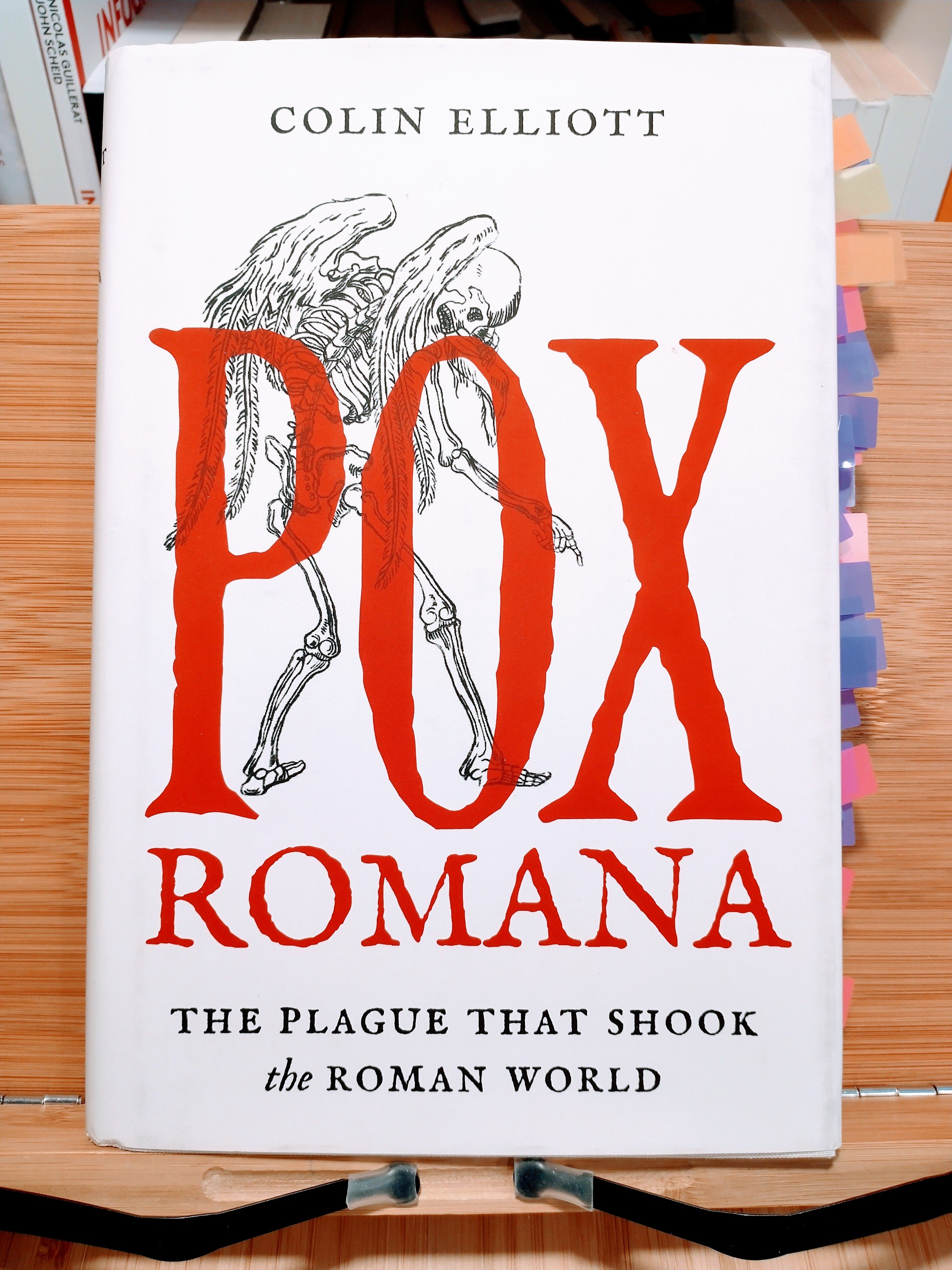
The recent experience of an eerily similar situation (which involved the emergence of another pandemic, the outbreak of war at the outskirts of Europe, political uncertainty, social conflict, ecological degradation, rising inflation, and a widespread decline in mental health) has led some historians to challenge this status quo and reconsider Dodds’ original proposal. The latest example of this trend can be found in Colin Elliott’s ingeniously titled Pox Romana, which focusses on the role of the Antonine Plague as a “catalyst for change” at the very end of the Pax Romana, the period of relative internal stability due to the convergence of benign but temporary ecological conditions and serendipitous geopolitical events that lasted from Augustus to Marcus Aurelius (ca. 31 BCE-180 CE; Elliott 2024: xx, 213, 216).
Lamented in the 19th century as a “grand tragedy” and later demoted to a historiographical “non-event” between the 1960s and 1970s, the Antonine Plague made a successful comeback on the historians’ agenda by the 1990s (Elliott 2024: xvii). However, the quantification of its real impact on the demise of the Roman empire, as well as its role on the changing religious landscape of the era, are still a source of heated debate. Given that any computational modelling of the pandemic is bound to fail due to the dearth of reliable proxies (Elliott 2024: 94; 255, note no. 90), Elliott tries to solve this puzzle by adopting a multidisciplinary approach that mixes an engrossing and global historiographical account with cutting-edge epidemiology, palaeogenetics, climate science, sociology, economics, and cognitive sciences. The reader is thus presented with a fascinating cornucopia of comparative data that includes Greenland ice samples to gauge declining imperial industrial production, Viking Age remains attesting to the evolutionary history of orthopoxviruses, ancient Egyptian tax and census records that capture village depopulation, coeval Roman epigraphs, Arabian inscriptions, sculptures of Kushan pox deities, and Chinese chronicles all relating the deadly outbreaks that may have been caused by the same pathogen, and even daring urban comparisons between cyclical smallpox epidemics in 18th-century Mexico City and imperial Rome. In this way the Antonine Plague regains its key historical role as both the Western end of the very first historically attested Afroeurasian pandemic (tentatively identified by Elliott in an extinct precursor to or relative of modern smallpox; Elliott 2024: 92), and a fundamental, yet neglected, shaper of the Axial Age and its (religious) mindscape.
In line with the Cognitive and Evolutionary Sciences of Religion’s renewed emphasis on anxiety as a key neurophysiological emotion that is tied to the detection of environmental threats and the management of uncertainty (usually assuaged by engaging in ritual behaviours), Elliott highlights the intergenerational psychosocial effects of the Antonine Plague on the minds and behaviours of the people (emperors included). To avoid any misunderstanding, though, he chooses to replace Dodds’ psychoanalytically-based “Age of Anxiety” with a cognitively-based “Age of Angst”, a reformulation originally proposed by pioneer cognitive historian Luther H. Martin (Elliott 2024: 112; cf. Martin 2013). In a society where health was intuitively understood through the lenses of religion (and vice versa), the new “everlasting pestilence” (Elliott 2024: 106) radically subverted the contractual and reciprocal logic behind the pax deorum, the “peace among gods” that underlined and secured the good relationship between the human community and the divine pantheon (Elliott 2024: 112). The pax deorum mirrored the patronage and clientelist system of Roman society; given that sickness was widely conceptualised as a message from the gods to flag social and moral impiety and prompt course correction, the failure of the godheads to do their part and stop the waves of pestilence notwithstanding a constant flurry of ritual offerings, talisman wearing, charlatans’ oracles, and magical formulae was met with existential anxiety, angst, and even scorn and disaffection, while impotent institutions continued to double down on traditional rituals and collective expiations with an obsessive-compulsive stubbornness (Elliott 2024: 112-113). Even the wise Stoic emperor Marcus Aurelius felt compelled to resort to the fraudulent oracular services of Glycon, a snake-god in the form of a “ventriloquist’s dummy” and “glove puppet” (as vividly defined by novelist and comic book maestro Alan Moore) that was the object of a faith-healing cult recently established by magician-messiah Alexander of Abonoteichus (Elliott 2024: 125-128; cf. Moore 2011).
Alas, no such remedy ever worked, and in time the Romans would be infected by the “spirit of pandemic”, a mix of indulged cognitive biases, unchallenged logical fallacies, and creeping authoritarianism that led to scapegoating and mass killings to please the god(s) and stave off disease (Elliott 2024: 234). Political action was limited to constant attacks against the merchants, the preservation of the elite patrimonial assets, and “the folly of command[ing] economics” by decree (Elliott 2024: 229). As Elliott cleverly notes implicitly mirroring Daniel Kahneman’s dual cognitive-function systemisation, totalitarian responses “signify reaction rather than reflection” (Elliott 2024: 238) and, as the empire began to exert absolute control on its citizens’ “employment, private religion, and even the prices for basic goods”, the accumulation of reactive and unreflective institutional responses altered the “imagined community” of the Roman state forever (Elliott 2024: 238; cf. Kahneman 2011; on the concept of “imagined community” see Anderson 1983). No one was immune. The apocalyptic beliefs of early Christian communities, along with the promise of a better afterlife and possibly their differential survival rates (thanks to immunity acquired through tending to and caring for the sick and dying), helped them endure pain and suffering with joy, welcoming the persecutions of pagan emperors as a sign of the imminent divine judgment (Elliott 2024: 135, 237); but with the apocalypse indefinitely postponed, the ongoing and unpredictable epidemic waves left the cognitively suboptimal “spirit of pandemic” untouched when the empire officially adopted Christianity as state religion, which contributed to feed unabated levels of violence, turmoil, and state decay (Elliott 2024: 238).
And yet, Elliott tells us that the Antonine Plague itself, with an estimated death toll amounting to 5% to 10% of the empire’s population (which is dwarfed by the later Black Death and its staggering 50% mortality rate), was not the silver bullet that caused the collapse of the empire, but merely “a turning point”, or a “catastrophe-flip” that initiated a deadly domino effect on a system that even at its peak was already under stress (Elliott 2024: 226; 214-216). Economic cluelessness, widespread folk theories of contagion, and the absence of effective mitigation measures beyond euergetism made Roman society systemically unable to sustain the compounded effect of climate change and a new Euromediterranean pathocoenosis [2]. For instance, the El Niño Southern Oscillation-induced droughts in Africa and monsoon perturbation in the Indian Ocean affected the annual flooding of the Nile, which in turn negatively impacted the grain production of Egypt (the breadbasket of Rome), while the extension of the storm season in the Mediterranean limited maritime transportation and delayed grain supply; malnutrition, poor sanitation, and poverty provided a breeding ground for the proliferation of deadly pathogens and the spread of social unrest; and the exponential increase in Afroeurasian commerce and communication (with Egypt, again, at its most vulnerable crossroad) combined with ongoing and increasingly expensive imperial warfare to transform soldiers in disease vectors and the Old World in a giant Petri dish (Elliott 2024: 32-39; 4-15; 60-62; 72, 172).
The lesson of Elliott’s impeccably researched book is clear. Environmental cataclysms are always exacerbated and turned into epoch-defining catastrophes by poor decision making and institutional ignorance (Elliott 2024: 40). The Antonine Plague fuelled anxiety, anxiety turned into angst, angst bred panic, and panic led to scapegoating, persecutions, and the totalitarian politicisation of religion. Religion never happens in a void, and while history does not repeat itself, it sure does rhyme.
Notes
This is the unabridged and corrected version of the review published in BASR Bulletin 148 (May 2026): 19-20.
[1] A literal example of the relegation of the book’s thesis to a mere footnote can be found in Versnel 1990: 36, note no. 113, where we read that accepting a late antique “major change in religious experience” would “by no means impl[y] that we should re-embrace Dodds’ notion of ‘the Age of Anxiety’, rightly contested by Lane Fox”.
[2] This is the original definition of pathocoenosis: “the qualitatively and quantitatively defined group of pathological states present in a given population at a given time. The frequency and the distribution of each disease depend not only on endogenous – infectivity, virulence, route of infection, vector – and ecological factors – climate, urbanization, promiscuity – but also on frequency and distribution of all the other diseases within the same population.” From Gonzalez et al. 2010: 237-238, originally in Gmerk 1969.
Refs.
Anderson, Benedict. 1983. Imagined Community: Reflections on the Origin and Spread of Nationalism. London: Verso.
Dodds, E.R. 1965. Pagan and Christian in an Age of Anxiety. Cambridge: Cambridge University Press.
Elliott, Colin. 2024. Pox Romana: The Plague that Shook the Roman World. Princeton and Oxford: Princeton University Press. https://doi.org/10.2307/jj.5806815
Fox, Robin Lane. 1986. Pagans and Christians. London: Penguin.
Gonzalez, Jean-Paul, Micheline Guiserix, Frank Sauvage, Jean-Sébastien Guitton, Pierre Vidal, Nargès Bahi-Jaber, Hechmi Louzir, and Dominique Pontier. 2010. “Pathocenosis: A Holistic Approach to Disease Ecology.” EcoHealth 7(2): 237-241. https://doi.org/10.1007/s10393-010-0326-x
Grmek, Mirko D. 1969. “Préliminaire d’une étude historique des maladies.” Annales. Histoire, sciences sociales 24: 1437-1483. https://doi.org/10.3406/ahess.1969.422182
Kahneman, Daniel. 2011. Thinking, Fast and Slow. New York: Farrar, Straus and Giroux / London: Penguin.
Lim, Richard. 2010. “The Later Roman Empire.” In The Oxford Handbook of Roman Studies, edited by Alessandro Barchiesi and Walter Scheidel, 547-563. Oxford: Oxford University Press 2010. https://doi.org/10.1093/oxfordhb/9780199211524.013.0035
Martin, Luther H. 2013. “The Ecology of Threat Detection and Precautionary Response from the Perspectives of Evolutionary Psychology, Cognitive Science and Historiography: The Case of the Roman Cults of Mithras.” Method & Theory in the Study of Religion 25 (4-5): 431-450. https://doi.org/10.1163/15700682-12341305
Moore, Alan. 2011. “Alan Moore’s Alternative Thought for the Day.” BBC, 31 December. http://news.bbc.co.uk/today/hi/today/newsid_9669000/9669590.stm; recording available on YouTube (https://www.youtube.com/watch?v=zSWO6LF7Cd4) [Last Accessed 21 May 2026].
Morgan, Teresa. 2019. “Pagan and Christians: Fifty Years of Anxiety.” In Rediscovering E.R. Dodds: Scholarship, Education, Poetry, and the Paranormal, edited by Christopher Stray, Christopher Pelling, and Stephen Harrison, 183-197. Oxford: Oxford University Press. https://doi.org/10.1093/oso/9780198777366.003.0009
Versnel, H. S. 1990. Ter Unus: Isis, Dionysos, Hermes. Three Studies in Henotheism. Leiden and New York: Brill.